
- India
- Aug 24
Kailash Mansarovar Yatra through Nathu La concludes
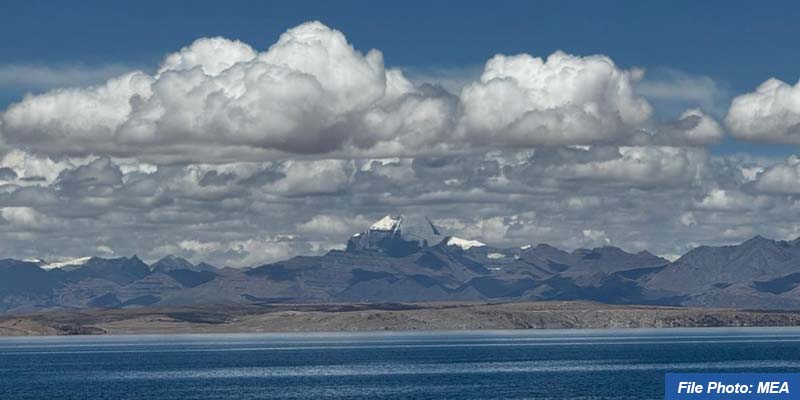
• The Kailash Mansarovar Yatra through Sikkim’s Nathu La route concluded on August 23, with 464 pilgrims completing the pilgrimage in 10 batches.
• The yatra, which began on June 20, concluded with the return of the final batch of pilgrims to Gangtok.
• The pilgrims visited Mount Kailash and Lake Manasarovar in the Tibet Autonomous Region of China.
• The Nathu La route has emerged as an important gateway for the pilgrimage, connecting Sikkim with one of the most revered spiritual destinations for devotees of various faiths.
Kailash Mansarovar Yatra
• The Kailash Mansarovar Yatra is a sacred pilgrimage to Mount Kailash and Lake Manasarovar in the Tibet Autonomous Region of China.
• Ministry of External Affairs organises the yatra every year from June to August/September in cooperation with the state governments of Uttarakhand, Uttar Pradesh and Sikkim, along with Indo-Tibetan Border Police (ITBP), through the two official routes of Lipulekh Pass in Uttarakhand (since 1981) and Nathu la Pass in Sikkim (since 2015).
• Mount Kailash has an altitude of 6,638 metres.
• It is one of the highest parts of the Himalayas and serves as a source of some of the longest rivers in Asia — Indus, Sutlej, Brahmaputra, and Ghaghara (Karnali).
• It is known as Gang Tise or Gang Rinpoche in Tibet.
• Lake Mansarovar is located at the southern foot of Mount Kailash. The shape of Lake Manasarovar is round with around 88 km circumference.
• The Kailash Mansarovar Yatra is known for its religious and cultural significance. It is undertaken by hundreds of people every year.
• The yatra is open to eligible Indian citizens holding valid Indian passports who wish to proceed to Kailash-Mansarovar for religious purposes.
Key points on Nathu La Pass:
• Nathu La is a mountain pass in the Himalayas in East Sikkim district.
• It connects the Indian state of Sikkim with Tibet Autonomous Region.
• The pass, at 4,310 m (14,140 feet) above mean sea level, forms a part of an offshoot of the ancient Silk Road.
• Nathu means listening ears and La means pass in Tibetan.
• On the Indian side, the pass is 54 km east of Gangtok, the capital of Sikkim.
• Only citizens of India can visit the pass, and then only after obtaining a permit in Gangtok.
• Nathu La is one of the three open trading border posts between China and India.
• The others are Shipkila in Himachal Pradesh and Lipulekh (or Lipulech) at the trisection point of Uttarakhand India, Nepal and China.
• Sealed by India after the 1962 Sino-Indian War, Nathu La was re-opened in 2006 following numerous bilateral trade agreements.