
- India
- Aug 23
National Space Day on August 23
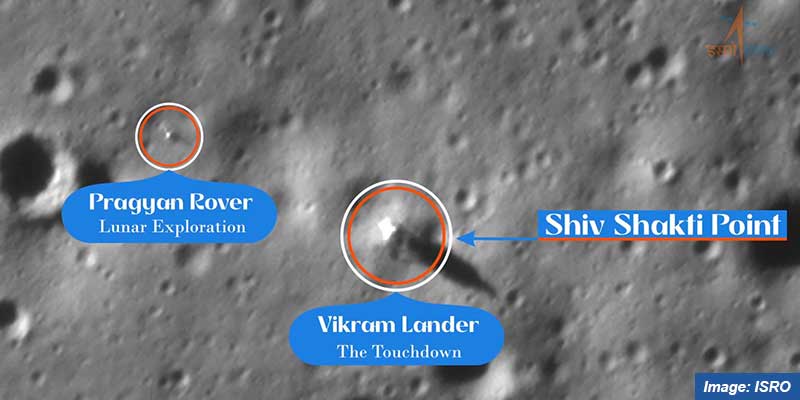
• India celebrates National Space Day on August 23.
• It commemorates the day when the Vikram Lander of Chandrayaan-3 mission successfully touched down on the Moon’s south polar region on August 23, 2023.
• Chandrayaan-3’s landing point on the Moon is named ‘Shiv Shakti’.
Private investment in India’s space sector
• India is expanding its capabilities across launch systems, satellites, space applications and human spaceflight.
• India’s space economy is valued at $9 billion as of August 2026. It is projected to reach $40-45 billion over the next decade.
• India’s global partnerships reinforce its growing space leadership, with over 300 space cooperation agreements across 61 countries and five multilateral organisations, covering research, technology, joint missions and capacity building.
• India opened its space sector to private participation in 2020, enabling industry and startups across satellites, launch systems and space applications. This marked a major shift towards a broader national space ecosystem.
• Private investment in India’s space sector surged nearly six-fold, climbing from $100.5 million in 2021-22 to $618.5 million by March 31, 2026, with $187 million recorded during 2026 alone.
• At present, there are around 440 space startups in India.
• The Indian Space Policy 2023 further expanded private participation across the space value chain.
• It also defined the roles and responsibilities of NewSpace India Limited (NSIL) and Indian National Space Promotion and Authorisation Centre (IN-SPACe).
• NSIL, the commercial arm of ISRO, provides launch, satellite and space-based services and transfers ISRO technologies to Indian industry.
• IN-SPACe enables private space activities through a single-window mechanism.
• Foreign Direct Investment (FDI) rules in February 2024 were liberalised for the space sector. Up to 74 per cent FDI is permitted automatically for satellite manufacturing and operations, 49 per cent for launch vehicles and spaceports, and 100 per cent for satellite and ground-segment components.
• Targeted financing is strengthening India’s private space ecosystem. The IN-SPACe Seed Fund Scheme supports early-stage space startups, the Rs 1,000 crore Venture Capital Fund provides growth capital, and the Rs 500 crore Technology Adoption Fund enables wider deployment of space technologies.
India’s key future space missions
• India is entering a new phase of human spaceflight, deep-space exploration and advanced space infrastructure.
• The Gaganyaan human spaceflight programme was approved in January 2019. Its scope was expanded and revised in September 2024 to a total outlay of Rs 20,193 crore encompassing eight total missions, including precursor flights for the Bharatiya Antariksh Station (BAS-01).
• It aims to launch a crew of three Indian astronauts to a 400-km orbit for a three-day mission.
• The first uncrewed experimental mission to validate various technologies including Vyommitra half-humanoid is targeted in 2026. The crewed mission is targeted by 2027.
• India’s planned five-module space station Bharatiya Antariksh Station (BAS) is targeted for operationalisation by 2035, with BAS-01 planned for launch by 2028.
• It will support long-duration human spaceflight, microgravity research and advanced space operations.
• Venus Orbiter Mission is targeted for launch in March 2028. The mission will study Venus’ geology, atmosphere and ionosphere. It will demonstrate advanced aerobraking and thermal-management technologies.