
- India
- Sep 03
Aditya-L1 catches Sun’s early warning signs before solar flares
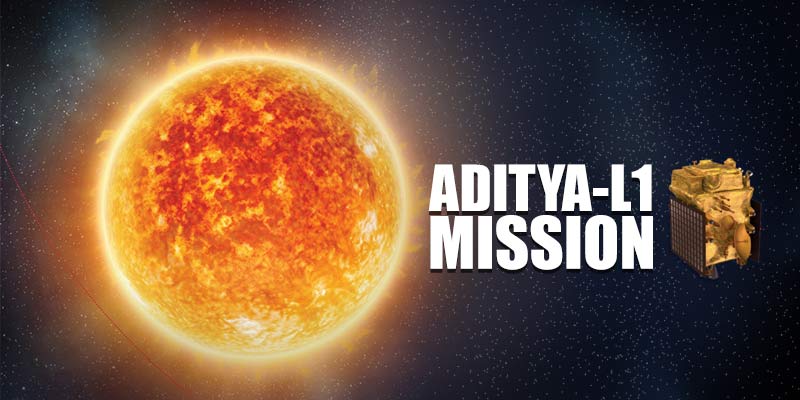
• Scientists using India’s solar observatory, Aditya-L1, have found small, short-lived brightening in the Sun’s atmosphere that appear hours before a major solar flare erupts and that cluster around the very spot where the flare later occurs.
• This study represents one of the first systematic investigations of pre-flare activity using simultaneous ultraviolet imaging and X-ray observations from a single observatory.
• The findings provide valuable insights into the physical processes that trigger solar flares and move scientists a step closer towards reliable flare forecasting — which will ultimately contribute to better space weather prediction, helping protect satellites, astronauts, communication systems and other critical technologies.
Key facts on Aditya-L1 mission:
• Aditya-L1 was launched on September 2, 2023, from the Satish Dhawan Space Centre in Sriharikota.
• The mission’s primary payload, the Visible Emission Line Coronagraph (VELC), was developed by the Indian Institute of Astrophysics (IIA) in Bengaluru.
• Aditya-L1 is the first space-based observatory class Indian solar mission to study the Sun.
• Aditya in Sanskrit means the Sun. L1 refers to Lagrange Point 1 of the Sun-Earth system.
• L1 is a location in space where the gravitational forces of two celestial bodies, such as the Sun and Earth, are in equilibrium. This allows an object placed there to remain relatively stable with respect to both celestial bodies.
• The spacecraft completed its first halo orbit around the Sun-Earth L1 point on July 2, 2024.
• The Lagrange Point 1 (L1) of the Sun-Earth system is approximately 1.5 million km away from the Earth, which is about 1 per cent of the Earth-Sun distance.
• A satellite placed in the halo orbit around the L1 point has the major advantage of continuously viewing the Sun without any occultation/eclipse.
• This will provide a greater advantage of observing the solar activities continuously.
What are solar flares?
• Solar flares are sudden and intense bursts of electromagnetic radiation from the Sun.
• It is understood to result from the release of magnetic energy. Large flares can disrupt radio communication, interfere with navigation systems, damage satellites, and increase radiation hazards for astronauts and spacecraft.
• Understanding how solar flares are triggered is therefore essential for improving space weather forecasting and protecting modern technological infrastructure.
How Aditya-L1 observes the Sun?
• By observing the Sun continuously from the Sun–Earth Lagrange Point 1 (L1), Aditya-L1 provides an uninterrupted view of solar activity across multiple wavelengths.
• The Solar Ultraviolet Imaging Telescope (SUIT) observes the Sun in eleven near-ultraviolet (NUV) filters, revealing different layers from the upper photosphere to the chromosphere.
• NUV wavelengths are largely inaccessible from the ground because Earth’s atmosphere absorbs most ultraviolet radiation.
• Complementing SUIT are two X-ray instruments, the Solar Low Energy X-ray Spectrometer (SoLEXS) and the High Energy L1 Orbiting X-ray Spectrometer (HEL1OS), which measure the X-ray emission produced by energetic processes in the solar corona.
• Combining these data scientists study how activity in the lower solar atmosphere is linked to energy release in the corona during the build-up to a flare.