
- India
- Sep 08
- Sreesha V.M
NITI Aayog launches Platform for Aggregating Clean Transport (PACT)
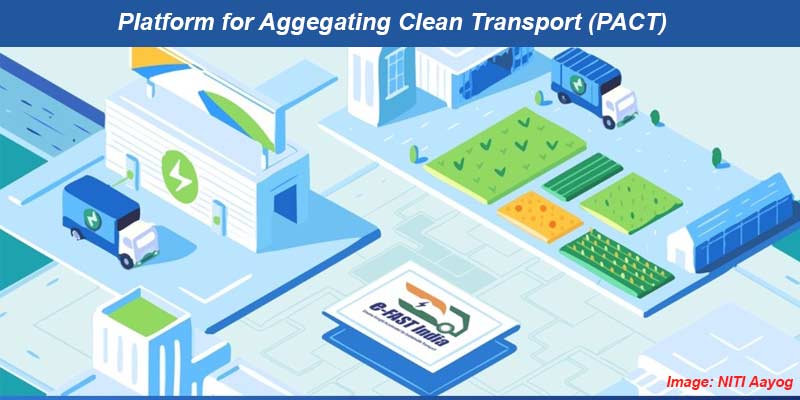
• NITI Aayog launched the Platform for Aggregating Clean Transport (PACT) at the 5th e-FAST India Summit 2026 on September 7.
• It marks a significant step towards accelerating the deployment of zero-emission trucks in India.
Highlights of PACT:
• It is designed to aggregate freight demand from shippers, Logistics Service Providers (LSPs) and other ecosystem stakeholders and translate it into deployment opportunities across identified freight corridors.
• By bringing together shippers, LSPs, vehicle manufacturers, financiers, charge point operators (CPOs) and other ecosystem partners, the platform aims to improve demand visibility, support charging infrastructure planning and strengthen the commercial case for electric medium and heavy-duty vehicles (e-MHDVs).
• The launch comes at a time when India’s electric freight market is gathering pace.
• E-freight vehicle deployments increased more than four-fold, from 201 vehicles in FY25 to 826 in FY26.
• Today, over 3,000 e-MHD trucks are in operation across the country.
• Sustaining and scaling this momentum will require coordinated action to aggregate demand, expand charging infrastructure, improve access to finance, and provide greater certainty for fleet operators and investors.
• While significant progress has been made in building domestic EV manufacturing capacity and supportive policy mechanisms, the next phase of growth will depend on our ability to address ecosystem-wide challenges through collaboration.
• As freight electrification gains momentum, innovative financing models, corridor-based charging infrastructure, and market-driven partnerships will be critical to accelerating the commercial adoption of e-trucks and strengthening India’s clean mobility future.
• Accelerating electric freight mobility will require innovations in logistics operations, financing charging infrastructure, and battery governance.
• Measures such as battery health monitoring systems and new operating models for high-utilisation vehicles can improve transparency, strengthen resale value, reduce financing risks, and unlock greater investment.
• With growing industry interest and rising demand, India is well positioned to build a scalable and commercially viable electric trucking ecosystem that advances both logistics competitiveness and energy security.
(The author is a trainer for Civil Services aspirants.)