
- India
- Sep 09
- Sreesha V.M
Railways completes Dedicated Freight Corridor network
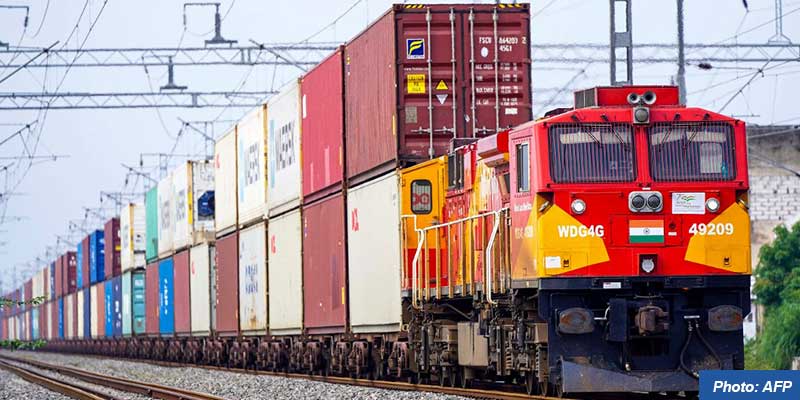
• Prime Minister Narendra Modi dedicated to the nation three important sections of the Western Dedicated Freight Corridor (WDFC).
• These include the New Sanand (N)-New Makarpura, New Umbergaon-New Saphale and New Saphale- New JNPT sections sections.
• With the commissioning of these three sections, India’s 2,843-km Dedicated Freight Corridor (DFC) is now operational across its entire length.
• The dedicated freight infrastructure will further strengthen the country’s logistics ecosystem by improving multimodal connectivity, reducing transit time and facilitating seamless movement of cargo across different regions.

Highlights of Dedicated Freight Corridors:
• Ministry of Railways had taken up construction of two Dedicated Freight Corridors (DFCs) — Eastern Dedicated Freight Corridor (EDFC) and Western Dedicated Freight Corridor (WDFC), together spanning approximately 2,843 km, built at a total cost of Rs 124,005 crore.
• The operationalisation of DFCs is bringing a significant transformation to India's freight transportation network by providing high-capacity, faster, more efficient and reliable rail connectivity between major industrial, manufacturing and logistics centres across the country.
• The 1,337-km EDFC begins at New Sahnewal in Punjab and extends through Haryana and Uttar Pradesh to New Sonnagar in Bihar.
• The 1,506-km WDFC starts at New Dadri in Uttar Pradesh and passes through Haryana, Rajasthan and Gujarat before reaching New JNPT in Maharashtra.
• On an average about 443 trains are operated per day on DFCs.
• The DFCs have demonstrated robust operational performance. Freight volumes have steadily increased, with higher average speeds, faster turnarounds, and enhanced reliability.
• It has contributed to creating additional paths on the conventional network by diverting freight traffic to EDFC and WDFC.
• As a result, Railways have been able to run additional goods and coaching services over its network.
• It will have a positive impact on transportation and logistics sector as it will enable enhanced movement of Double Stack Container (DSC) trains, higher axle load trains, faster access of northern hinterland by Western Ports and development of new terminals/linkages with industries along the DFC.
(The author is a trainer for Civil Services aspirants.)