
- India
- Sep 13
- Sreesha V.M
BRICS nations adopt New Delhi Declaration
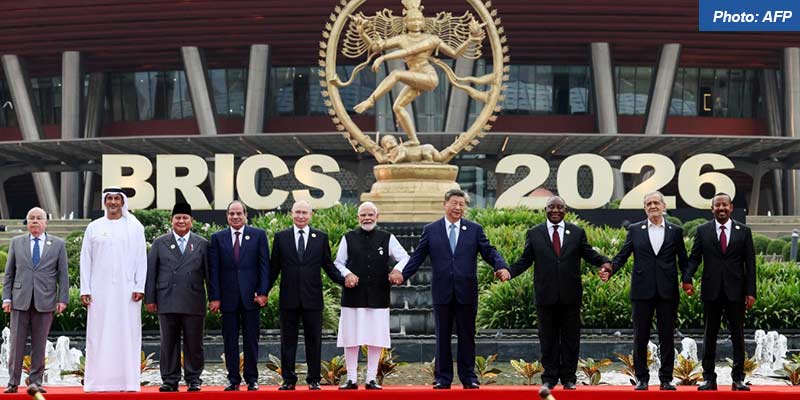
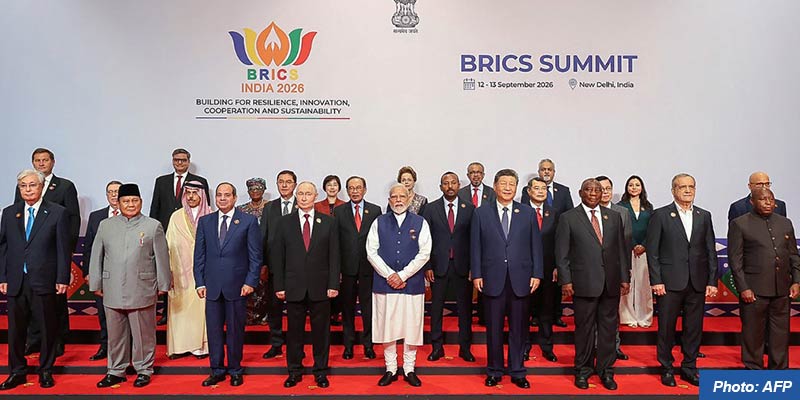
• The member countries adopted a consensus joint New Delhi Declaration during the 18th BRICS Leader’s Summit in New Delhi on September 12.
• Prime Minister Narendra Modi announced the adoption of the declaration in the presence of Chinese President Xi Jinping, Russian President Vladimir Putin, Iranian President Masoud Pezeshkian, Abu Dhabi Crown Prince Mohamed bin Zayed Al Nahyan and other top leaders of the bloc.
• The New Delhi Declaration is seen as a major triumph for Indian diplomacy.
Highlights of New Delhi Declaration:
i) Call for peace in West Asia region: The declaration expressed deep concern over the continued escalation of tensions in Middle East/West Asia. The leaders encourage increasing efforts, through dialogue and diplomacy, towards a long-term understanding that will contribute to lasting peace, security and stability in the region. They stressed the need to work together to maintain smooth flow of global trade, supply chains and energy, in accordance with applicable international law.
ii) Pahalgam attack denounced: The leaders condemned in the strongest terms the terrorist attack in Pahalgam, Jammu & Kashmir on April 22, 2025, during which 26 people were killed and many more injured. They reiterated that all those involved in terrorist activities and their support must be held accountable and brought to justice in accordance with relevant national and international law. They emphasized that the primary responsibility of States in combating terrorism and that global efforts to prevent and counter terrorist threats must fully comply with their obligations under international law.
iii) Tariffs called out: The multilateral trading system has long been at a crossroads. The proliferation of trade-restrictive actions that are inconsistent with World Trade Organisation (WTO) rules, whether in the form of indiscriminate rising of tariffs and non-tariff measures, or protectionism under the guise of environmental objectives, threatens to further reduce global trade, disrupt global supply chains, and introduce uncertainty into international economic and trade activities.
iv) Strikes near nuclear facilities flagged: The leaders expressed serious concern over deliberate attacks on civilian infrastructure and peaceful nuclear facilities under full safeguards of the International Atomic Energy Agency (IAEA), in violation of international law and relevant resolutions of the IAEA. Nuclear safeguards, safety, and security must always be upheld, including in armed conflicts, to protect people and the environment from harm.
v) Call for UN reforms: Recalling the 2022 Beijing and 2023 Johannesburg-II Leaders’ Declarations, China and Russia, as permanent members of the UN Security Council, reiterated their support to the aspirations of Brazil and India to play a greater role in the UN, including its Security Council.
vi) Unilateral sanctions condemned: The leaders condemned the imposition of unilateral coercive measures and reiterated that such measures, in the form of unilateral economic sanctions and secondary sanctions, have far-reaching negative implications. They called for the elimination of such unlawful measures, which undermine international law and the principles and purposes of the UN Charter.
vii) Oppose carbon border taxes: The leaders opposed unilateral, punitive, discriminatory and protectionist measures that are not in line with international law, such as Carbon Border Adjustment Mechanisms. They expressed concern that such measures undermine efforts by countries, specifically the developing countries, aimed at addressing the adverse impacts of climate change, increasing adaptive capacity and resilience.
viii) Promoting cross-border payments: They acknowledged the efforts of the BRICS Payment Task Force (BPTF) towards exploring pragmatic solutions for efficient cross-border payment mechanisms, drawing on the guidance, provided in the Kazan and Rio Declarations, on the BRICS Cross-Border Payments Initiative. They acknowledged the work done to study the cross-border interoperability of payment and messaging channels, and the discussions on promoting trade settlements and investments using BRICS local currencies, while respecting national priorities.
ix) Plan to establish a grain trading platform: They acknowledged the importance of continued elaboration of the initiative to establish a grain trading platform within BRICS (the BRICS Grain Exchange) and further discussions on the modalities of its functioning and its subsequent development, and expanding into other agricultural products and commodities. They agreed to the establishment of a collaborative, non-binding, and farmer-centric BRICS AGRIN (Agro-Inputs, Genetic Resources, and Information Network), drawing upon relevant national, regional, and international practices.
• The declaration extended support to China for its BRICS Chairship in 2027 and the holding of the XIX BRICS Summit in China.
(The author is a trainer for Civil Services aspirants.)