
- India
- Sep 14
Govt bats for scaling up steel slag road technology
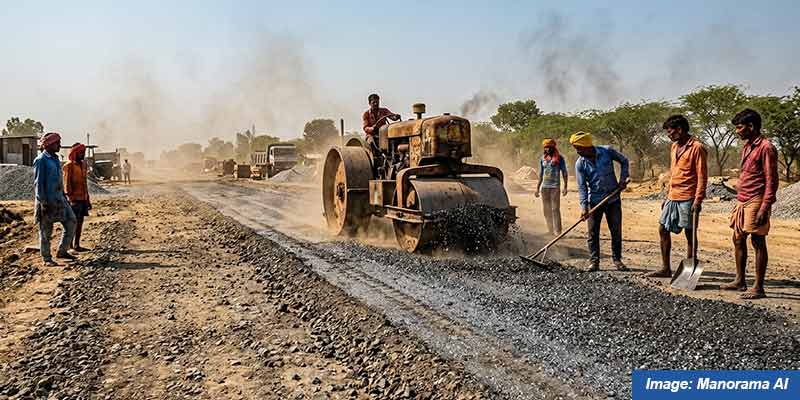
• Steel slag technology can reduce road construction costs by around 40 per cent while delivering four times the strength of conventional roads, Union Minister Jitendra Singh said.
• Steel slag is a waste by-product of the steel manufacturing process.
• The minister said the technology can also substantially extend the maintenance cycle, making it a breakthrough with implications not only for road engineering but also for the overall infrastructure economy.
• Jindal Steel Limited, in collaboration with CSIR-Central Road Research Institute (CSIR-CRRI), has achieved a Guinness World Records title for constructing the longest road built exclusively with processed steel slag aggregates at Raigarh in Chhattisgarh.
• Around 2 lakh tonnes of processed steel slag has been used to build the 1.85-km four-lane road, replacing natural aggregates and reducing dependence on quarrying.
Steel slag road technology
• India is world’s second largest producer of steel and accounts for generation of around 19 million tonnes of steel slag per annum from various integrated steel plants as solid waste.
• Majority of steel slag after metal recovery ends as a waste dump or as landfill in and around the steel plants which occupy huge tracts of land and cause air, land and water pollution.
• Scientifically processed steel slag for roads provides significant advantages over traditional construction materials.
• The steel slag roads are about 30 to 40 per cent more cost-effective and can last up to three times longer than standard bitumen roads, reducing repair and maintenance needs.
• Their strength makes them suitable for diverse climate conditions — from coastal regions to rugged terrains.
• Steel slag generation is expected to reach 60 million tonnes in the next few years, considering the ongoing capacity augmentation in Indian steel plants with an aim to produce 300 million tonnes of steel by 2030-31.
• The technology has already travelled through a series of landmark applications.
• Beginning with a major demonstration at Hazira, Gujarat, processed steel slag aggregates were used in a six-lane road connecting the industrial area with Hazira Port.
• It subsequently reached the NH-66 Mumbai-Goa Highway, where approximately 80,000 tonnes of steel slag were converted into processed aggregates for a one-kilometre, four-lane road section.
• The technology was also deployed for heavy-duty road infrastructure in Arunachal Pradesh, including the strategic border region.
• The steel ministry is promoting the usage of steel slag road technology and actively collaborating with the Ministry of Science & Technology and the Ministry of Road Transport & Highways to facilitate the large-scale utilisation of the industrial by-product.