
- India
- Sep 16
- Sreesha V.M
Govt sets 0.4% fee on UPI merchant payments above Rs 2,000
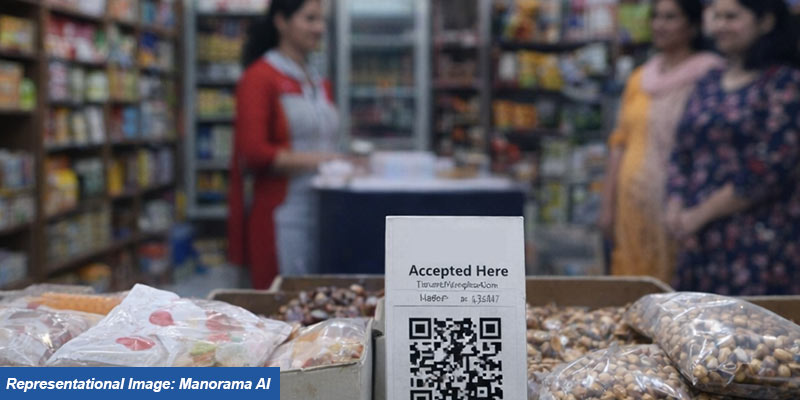
• From October 15, a 0.4 per cent Merchant Discount Rate (MDR) will be levied on person-to-merchant (P2M) transactions above Rs 2,000 through Unified Payments Interface (UPI).
• The charge will be paid by merchants, and not consumers, the Ministry of Finance said.
• The operational parameters, fee distribution models, and category caps are decided by the UPI and Services Steering Committee, headed by the National Payments Corporation of India (NPCI).
What is Merchant Discount Rate?
• The Merchant Discount Rate (MDR) is a fee charged by payment processors, banks, or card networks to business owners for processing digital payments by a customer.
• In January 2020, to promote digital transactions, MDR was made zero for BHIM-UPI transactions through amendments in Section 10A in the Payments and Settlement Systems Act, 2007 and section 269SU of the Income-tax Act, 1961.
• Data analysis indicates that MDR will apply to only about 4 per cent of merchant transactions.
• This means that approximately 96 per cent of merchant transactions will remain unaffected, as they are either below the Rs 2,000 threshold or covered by the zero-MDR framework for small merchants.
• For transactions of Rs 75,000 and above, the MDR will be capped at Rs 300 per transaction.
• Transactions above Rs 2,000 in essential and thin-margin sectors, including railways, telecommunications, insurance, fuel and agricultural inputs, will attract a flat MDR of Rs 5 per transaction.
• Payments relating to mutual funds, securities, stockbrokers and dealers will attract an MDR of 0.02 per cent, capped at Rs 300 per transaction.
• Banks have been advised to ensure that merchants do not pass MDR charges on to customers.
• The finance ministry clarified that MDR is neither a tax nor a charge collected by the government or NPCI.
• It is distributed among payment ecosystem participants, including banks and payment application providers, to further invest into infrastructure resiliency, innovation and cybersecurity.
What kind of UPI transactions will remain free?
i) All person-to-person (P2P) UPI transactions will remain free, irrespective of the amount transferred. No transaction fee, platform fee or other charge may be imposed on individuals for sending or receiving money through UPI.
ii) All person-to-merchant (P2M) UPI transactions up to Rs 2,000 will remain free of MDR. Customers will not be required to pay any charge when making such payments through UPI.
iii) Small merchants including street vendors receiving up to Rs 1 lakh per month through UPI QR codes under the person-to-person-merchant (P2PM) category will continue to enjoy zero MDR on all transactions.
• There are no monthly quotas, volume limits, or tiered caps on free UPI transactions for individual consumers.
Can merchants pass the MDR to buyers?
• The merchants cannot pass on MDR charges to customers while accepting payments through UPI. The framework ensures consumers pay only the posted price.
UPI MDR compared to debit and credit card MDRs
• UPI MDR is structured to be much lower than all traditional card-based transaction fees.
• Standard credit card MDRs typically range from 1.5 per cent to 2.5 per cent per transaction, while debit card MDRs are capped up to 0.90 per cent.
• UPI is a home-grown payment system, and its MDR is much lower than other payment instruments.
(The author is a trainer for Civil Services aspirants.)