
- India
- Sep 18
Jitendra Singh inaugurates India’s 51st Doppler Weather Radar at Sambalpur
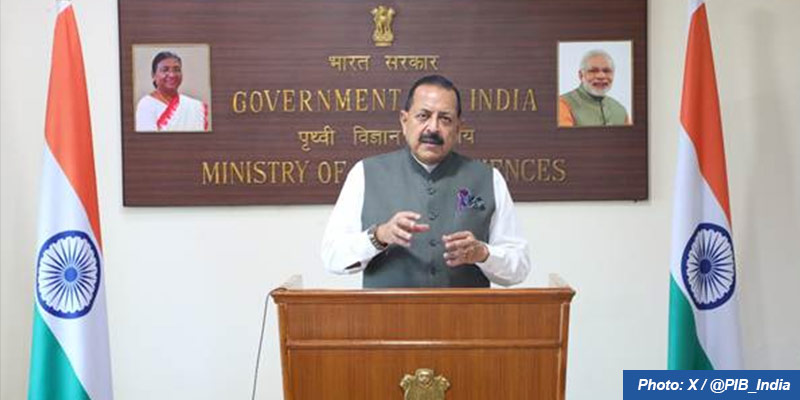
• Union Minister Jitendra Singh virtually inaugurated the country’s 51st Doppler Weather Radar at Sambalpur, Odisha in the presence of Chief Minister Mohan Charan Majhi.
• With the commissioning of the Sambalpur radar, Odisha now has three Doppler Weather Radars, following the installations at Gopalpur and Paradip.
• The new facility will strengthen weather observations over Western Odisha and provide improved meteorological inputs for adjoining areas of Southern Jharkhand, Northern Chhattisgarh and parts of North Andhra Pradesh and West Bengal.
• The facility will provide early warnings of pre-monsoon thunderstorms, lightning, hailstorms, heavy rain and cyclones.
• It will also facilitate precautionary measures in sectors such as power, industry, transportation and grid operations.
• Jitendra Singh said that around 40 more radars are planned under Mission Mausam.
• The expansion is part of the government’s broader effort to strengthen India’s capacity to observe, understand and respond to extreme weather events.
• Enhanced observation capabilities are particularly important for regions vulnerable to thunderstorms, lightning, heavy rainfall and other weather-related hazards.
Mission Mausam
• Mission Mausam is a central sector umbrella scheme of the Ministry of Earth Sciences (MoES).
• The goal is making India a “Weather-ready and Climate-smart Nation”.
• It aims to strengthen Earth system observations and prediction systems, improve early warnings for high-impact weather events, and deliver seamless weather and climate services, thereby enhancing climate resilience and disaster preparedness.
• The Union Cabinet approved Mission Mausam in 2024 with a budget outlay of Rs 2,000 crore for 2024-25 and 2025-26.
The major objectives of Mission Mausam are:
i) Developing cutting-edge weather surveillance technologies and systems.
ii) Implementing higher-resolution atmospheric observations with improved temporal and spatial sampling and coverage.
iii) Deploying next-generation Doppler Weather Radars, wind profilers, and satellites equipped with advanced instrument payloads.
iv) Implementing advanced high-performance computing systems.
v) Enhancing our understanding of weather and climate processes and improving prediction capabilities.
vi) Developing advanced Earth system models and data-driven methods.
vii) Creating technologies and protocols for effective weather management.
viii) Establishing a state-of-the-art decision support system and dissemination system for last-mile connectivity.
ix) Strengthening capacity building and research collaborations.