
- India
- Sep 18
PM Modi inaugurates 5th edition of SEMICON India
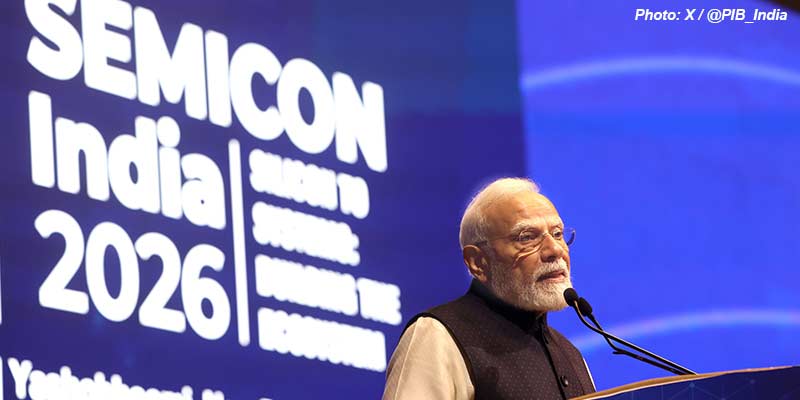
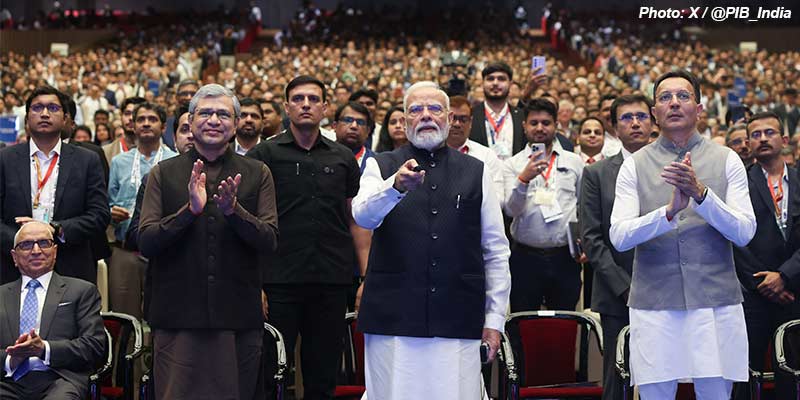
• Prime Minister Narendra Modi inaugurated the fifth edition of SEMICON India in New Delhi.
• The theme of the three-day event is “Silicon to Systems: Building the Ecosystem”.
• Hosted at Yashobhoomi, SEMICON India features over 600 exhibitors, including approximately 300 international participants, six country pavilions and 12 Indian state pavilions.
• SEMICON India is country’s premier semiconductor conference and exhibition jointly organised by the India Semiconductor Mission (ISM), Ministry of Electronics & Information Technology (MeitY), Government of India, and SEMI.
• It serves as a flagship platform for bringing together the global semiconductor and electronics ecosystem to advance collaboration, innovation, manufacturing, investments and talent development, while supporting India's vision of becoming a trusted global hub for semiconductor and electronics manufacturing.
• SEMI is the global industry association connecting over 4,000 companies and 1.5 million professionals worldwide across the semiconductor and electronics design and manufacturing supply chain.
What is a semiconductor?
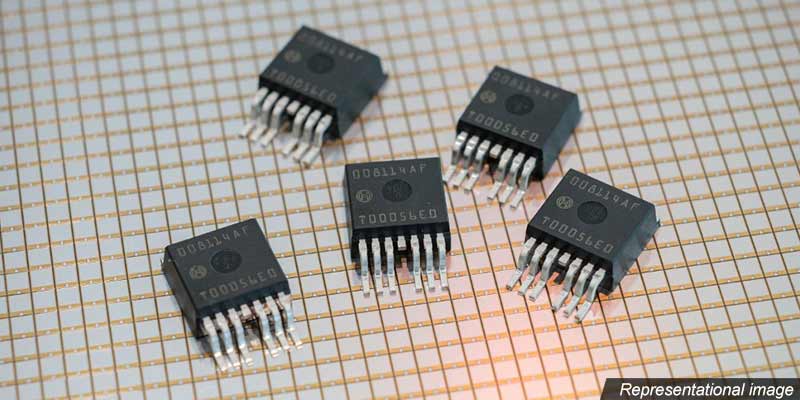
• A semiconductor is a material whose electrical conductivity can be controlled.
• Conductors such as copper allow current to flow easily, while insulators strongly resist it.
• Semiconductor materials can be engineered to switch, amplify, sense or control electrical signals.
• A transistor is a microscopic electronic switch. Modern integrated circuits place millions or billions of transistors and other components on a small chip.
• Their coordinated switching makes computing, communications, sensing, memory and power management possible.
• Most modern electronic devices depend on semiconductors. Smartphones, computers, medical equipment, automobiles, defence systems, satellites and data centres use semiconductor-based components.
• In simple terms, semiconductors are the building blocks of modern electronics.
Manufacturing of semiconductors
• Silicon is the most widely used semiconductor material.
• It is obtained from silica, which occurs abundantly in sand. Chip manufacturing begins with highly purified silicon, which is formed into cylindrical ingots.
• These ingots are sliced into thin wafers and polished. Inside fabrication plants, wafers undergo hundreds of carefully controlled processes. These include deposition, photolithography, etching and ion implantation.
• During photolithography, patterns are transferred onto the wafer using light.
• These patterns define structures that ultimately form transistors, interconnects and other parts of a chip.
• Transistors are the microscopic electronic switches on the chip that control the flow of electrical current.
• The process is repeated across multiple layers to build complex integrated circuits.
• Finished semiconductor devices then undergo Assembly, Testing, Marking and Packaging (ATMP) or Outsourced Semiconductor Assembly and Test (OSAT) processes.
• Packaging protects the chip and enables it to connect with other electronic components.
Importance of domestic manufacturing of semiconductors
• Semiconductors have emerged as a strategic resource for economic growth, technological leadership and national security.
• Today, Taiwan, South Korea, Japan, China and the United States dominate global semiconductor manufacturing.
• Taiwan alone accounts for over 60 per cent of global chip production and nearly 90 per cent of advanced chips.
• This concentration has highlighted the need for secure, diversified and resilient semiconductor supply chains.
• For India, domestic semiconductor capabilities are more than an industrial opportunity.
• They are essential for reducing import dependence, strengthening national security and creating high-value employment.
• They can also deepen technological self-reliance and reduce vulnerabilities across strategic sectors.
• No single country controls the complete semiconductor value chain. Different economies lead in chip design, fabrication, equipment, materials, memory and packaging.
• This specialisation has improved efficiency, but it also creates concentration risk.
• India’s semiconductor journey has evolved from building strategic capabilities to creating a broader domestic ecosystem.
• Early institutions such as the Semiconductor Laboratory (SCL) laid the groundwork, while recent policy interventions have accelerated investment, innovation and talent development.
• These efforts are positioning India to participate across the semiconductor value chain.
Semicon 1.0
• The government approved Semicon 1.0 in December 2021, with an outlay of Rs 76,000 crore.
• It aimed to establish a domestic semiconductor and display manufacturing ecosystem.
• The programme introduced dedicated schemes for setting up semiconductor fabs and display fabs.
• It also introduced the scheme for setting up compound semiconductors, silicon photonics, sensors and semiconductor ATMP/OSAT facilities.
• Additionally, the Design Linked Incentive (DLI) Scheme strengthened India’s semiconductor design capabilities.
• Together, these schemes established the foundation across chip design, fabrication, packaging and related technologies.
Semicon 2.0
• In July 2026, the Union Cabinet approved the Semicon 2.0 for the development of India’s semiconductor design and manufacturing ecosystem, with a total budget outlay of Rs 1,27,500 crore.
• It recognises the requirement for a sustained and long-term support to the semiconductor sector in India and also to build on the momentum generated under Semicon 1.0.
• Semicon 1.0 concentrated mainly on fabs and ATMP/OSAT plants.
• Semicon 2.0 adds machines and materials, design, research and talent to the mission.
• Together, the two phases span the chain from raw materials to finished chips.
Semicon 2.0 rests on six pillars:
i) Design
ii) Machines and materials
iii) Setting up new fabs
iv) Further strengthening the ATMP/OSAT industry
v) Research & Development
vi) Talent development.
• Its purpose is to build the complete chip value chain within the country, and not merely its closing stages.
• This effort carries India towards supply chain resilience, strategic autonomy and high-value employment in a technology that now underpins every modern industry.