
- India
- Sep 21
Govt approves biovigilance programme
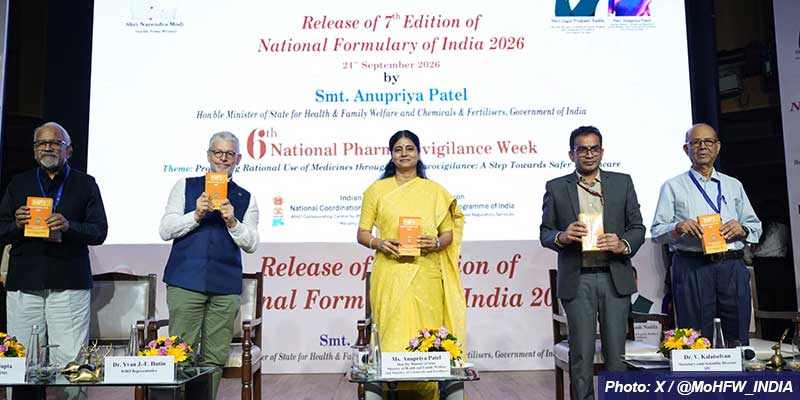
• In a significant expansion of India’s patient-safety framework, Union Minister of State for Health & Family Welfare Anupriya Patel announced that the biovigilance programme has been approved by the government of India.
• Under the programme, the Indian Pharmacopoeia Commission (IPC) will play a lead role in strengthening the reporting, assessment, monitoring and prevention of adverse events associated with medicines and biological products used in organ and tissue transplantation, including products administered to donors and recipients.
• Together, the pharmacovigilance, materiovigilance and biovigilance initiatives will strengthen safety monitoring across medicines, medical devices and transplant procedures.
• Pharmacovigilance is the science and activities relating to the detection, assessment, understanding and prevention of adverse effects or any other medicine/vaccine related problem.
• Materiovigilance is the coordinated system of identification, collection, reporting, and analysis of any untoward occurrences associated with the use of medical devices and protection of patient's health by preventing its recurrences.
Indian Pharmacopoeia Commission (IPC)
• The Indian Pharmacopoeia Commission was established in 2005.
• It is an autonomous institution of the Ministry of Health and Family Welfare.
• It became fully operational from January 1, 2009.
• The IPC was created to set standards of drugs in the country. Its basic function is to regularly update the standards of drugs commonly required for treatment of diseases prevailing in this region.
• It publishes official documents for improving quality of medicines by way of adding new and updating existing monographs in the form of Indian Pharmacopoeia.
• IPC promotes the rational use of generic medicines by publishing the National Formulary of India.
• The IPC’s mission is to promote public and animal health in India by bringing out authoritative and officially accepted standards for quality of drugs, including active pharmaceutical ingredients, excipients and dosage forms, used by health professionals, patients and consumers.
• This is achieved by developing the standards for medicines and supporting their implementation. In addition, the IPC also develops Indian Pharmacopoeia Reference Substances (IPRS), which act as a fingerprint for identification of an article under test and its purity as prescribed in the IP monographs.
• The Commission has a three-tier structure, comprising the General Body, the Governing Body and the Scientific Body, which are supported by the IPC Secretariat and the Indian Pharmacopoeia Laboratory (IPL).
• The IPC Secretariat and IPL scientists with the support of different advisory expert committees and expert members of the Scientific Body examine the suitability of the standards to be included in Indian Pharmacopoeia.