
- India
- Sep 23
President Murmu presents 72nd National Film Awards
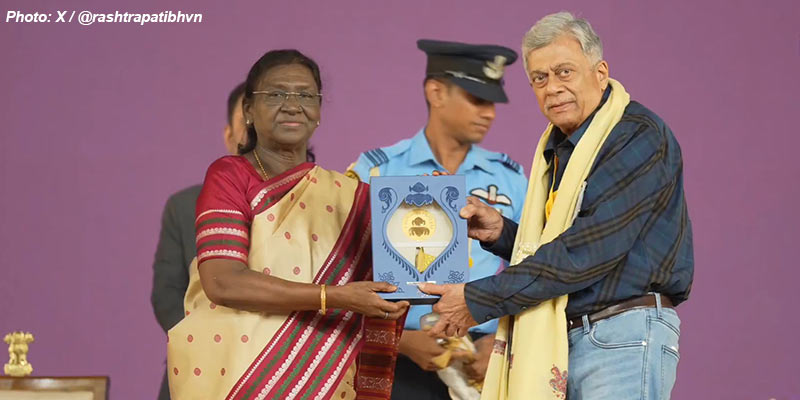
• President Droupadi Murmu conferred the 72nd National Film Awards for 2024 at Ekta Nagar (formerly Kevadia) in Gujarat's Narmada district.
• Ekta Nagar is famous for the Statue of Unity, the tallest statue of Sardar Vallabhbhai Patel.
• Veteran actor Anant Nag received the Dadasaheb Phalke honour.
• Yami Gautam received the Best Actress in a Leading Role award for ‘Article 370’.
• Hindi feature film ‘Article 370’, directed by Aditya Suhas Jambhale, received the Best Feature Film award.
• Rajkumar Periasamy received the Best Direction award for the Tamil movie ‘Amaran’.
• ‘Kalki 2898 AD’ was named Best Popular Film Providing Wholesome Entertainment.
• Randeep Hooda won the Best Debut Film of a Director award for ‘Swatantrya Veer Savarkar’.
• ‘Bhangaar’ was adjudged Best Non-Feature Film and ‘Ram-Nami’ was named the Best Documentary.
• Filmmaker Jayaraj chaired the feature film jury for the 72nd National Film Awards.
• Aseem Sinha chaired the non-feature film jury. A. Chandrasekhar chaired the best writing on cinema jury.
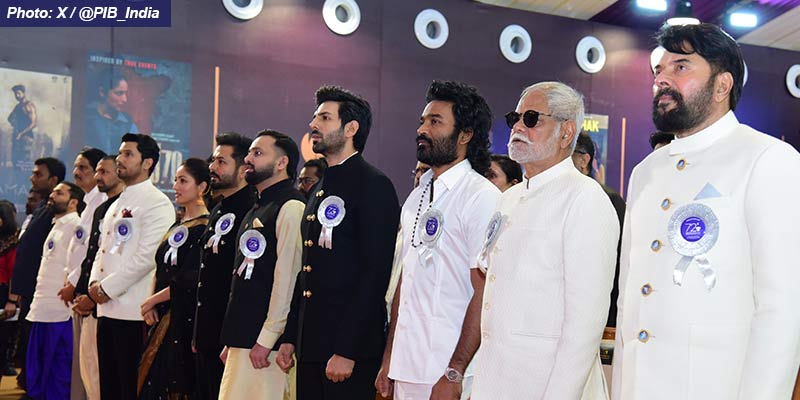
A brief history of National Film Awards
• The National Film Awards are the country’s most prestigious honours for excellence in the field of cinema.
• Instituted in 1954, they are conferred every year by the Ministry of Information and Broadcasting.
• Over seven decades, the awards have recognised outstanding creative and technical achievement in Indian filmmaking.
• The National Film Awards are organised in three sections, along with one lifetime honour.
• The feature film section is for full length films.
• The non-Feature film section for documentaries, short films, animation and other allied forms.
• The best writing on cinema section honours the best book and the best film critic.
• The Dadasaheb Phalke Award stands apart as the highest honour in Indian cinema.
• A Best Feature Film award is given in each language listed in Schedule VIII of the Constitution.
• Films in languages outside the Schedule are honoured through separate awards of their own.
• In the 72nd edition, ‘Dholi’ in Garhwali and ‘Imbu’ in Tulu were recognised under this provision.
The first edition of National Film Awards
• The journey of Indian cinema began in 1913 with Dadasaheb Phalke’s film ‘Raja Harishchandra’.
• The Film Enquiry Committee, set up in 1949, recommended the institution of the ‘State Awards for Films’.
• They were constituted to honor and encourage the artistic and technical excellence in Indian cinema. The awards were established in 1954 and the first edition honoured the films of 1953.
• The first edition covered three categories, namely feature films, documentary films and children’s films.
• ‘Shyamchi Aai’ in Marathi won the President’s Gold Medal for the Best All-India Feature Film.
• ‘Mahabalipuram’ won the President’s Gold Medal for the Best Documentary Film, and ‘Do Bigha Zamin’ received a Certificate of Merit.
Widening the canvas
• Awards for artists and technicians were separately established for the films of the year 1967.
• Uttam Kumar and Nargis received the first Best Actor and Best Actress awards in 1968.
• The Best Actor award was then called “Bharat” and the Best Actress award “Urvashi”.
• The Dadasaheb Phalke Award was instituted in 1969 and first presented to Devika Rani.
• New categories and technical crafts were added steadily as Indian cinema grew in range.
New venue for film awards
• In a major policy initiative, the Ministry of Information and Broadcasting has decided to take the celebration of the National Film Awards to different parts of the country in the coming years.
• The initiative will bring the celebration of Indian cinema closer to different regions and showcase the country’s rich cultural and cinematic diversity.