
- India
- Sep 22
- Sreesha V.M
PM Modi announces initiation of ‘Project Rhino’
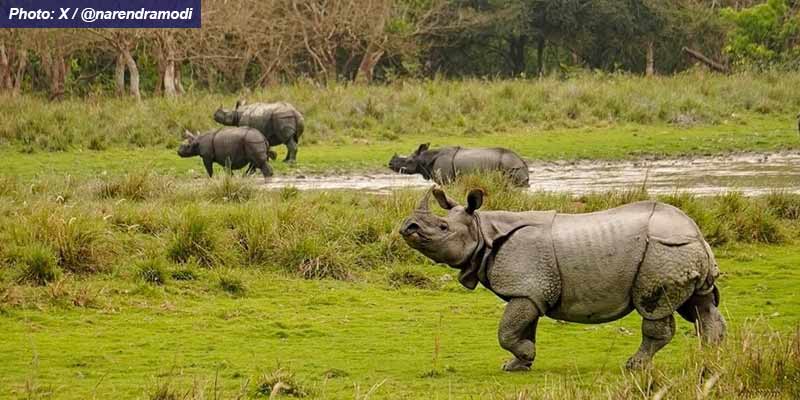
• World Rhino Day is celebrated on September 22.
• The day aims to raise awareness of the plight of rhinos because they are regularly poached for their horns which are sold illegally and used in traditional medicine, despite no scientific proof that these remedies work.
• Prime Minister Narendra Modi lauded the rhino conservation efforts in the country.
• He said the Project Rhino has been initiated for financial and technical support to the range states for protection, habitat management, and understanding population dynamics of the endangered species.
• On one hand, rhinos have either returned or are well protected in parts of Bihar and West Bengal. On the other hand, the success of reintroduction of rhinos in Dudhwa (Uttar Pradesh) is creating history, the PM said.
• Assam Chief Minister Himanta Biswa Sarma highlighted that the state is home to 80 per cent of the world's rhinoceros population and that zero poaching cases were registered in 2025.
• There are currently 3,260 rhinos in the state, and the government has so far destroyed 2,479 rhino horns seized from poachers.
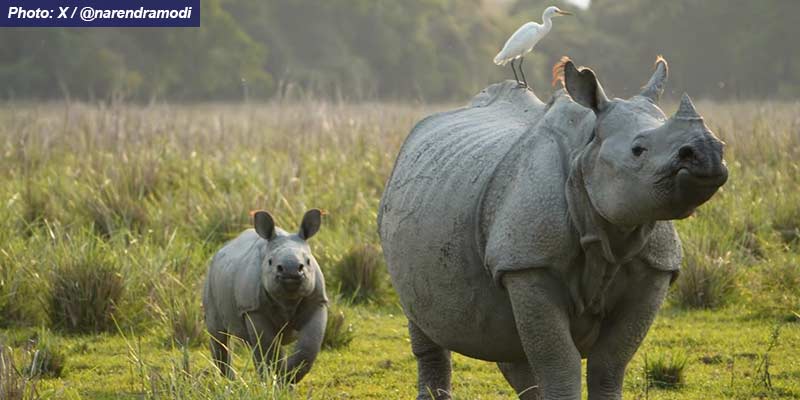
Key facts about Kaziranga National Park:
• In the heart of Assam, Kaziranga National Park and Tiger Reserve is located on the southern bank of the Brahmaputra River at the foot of the Mikir Hills. The Park lies in the floodplains of the Brahmaputra.
• Three-quarters or more of the area is submerged annually by the flood waters of the Brahmaputra.
• It was first constituted as Reserved Forest in 1908.
• This Park is one of the last areas in eastern India undisturbed by a human presence. It is inhabited by the world’s largest population of one-horned rhinoceroses, as well as many mammals, including tigers, elephants, panthers and bears, and thousands of birds.
• It was declared as a National Park in 1974.
• The Kaziranga National Park was inscribed on the UNESCO World Heritage List in 1985.
• Covering 42,996 hectares, it is the single largest undisturbed and representative area in the Brahmaputra Valley floodplain.
• The sanctuary hosts two-thirds of the world’s great one-horned rhinoceroses. Rhinos are listed as vulnerable on the IUCN Red list of Threatened Species.
• Kaziranga is regarded as one of the finest wildlife refuges in the world. The Park’s contribution in saving the Indian one-horned rhinoceros from the brink of extinction at the turn of the 20th century to harbouring the single largest population of this species is a spectacular conservation achievement.
• It is home to the highest density of tigers among protected areas in the world, and was declared a Tiger Reserve in 2006.
• It is an abode to approximately 478 species of both resident and migratory birds.
• The park has in its vicinity several notified forests and protected areas namely Panbari Reserve Forest and Deopahar Proposed Reserve Forest in Golaghat District, Kukurakata Hill Reserve Forest, Bagser Reserve Forest, Kamakhya Hill Reserve Forest in Nagaon District, Bhumuraguri Reserve Forest in Sonitpur District, North Karbi Anglong Wildlife Sanctuary in Karbi Anglong district. All these areas are of great ecological importance to the Kaziranga National Park.
(The author is a trainer for Civil Services aspirants.)