
- India
- Sep 26
India, GCC review implementation of joint action plan
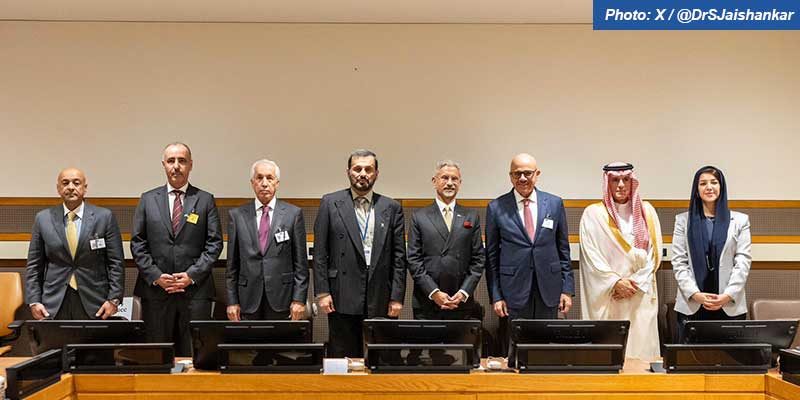
• Minister of External Affairs S. Jaishankar co-chaired the India-Gulf Cooperation Council (GCC) Troika Ministerial Meeting in New York on the margins of the UNGA on September 26.
• They reviewed the implementation of the India-GCC Joint Action Plan (JAP) 2024-2028, which was adopted at the first India-GCC Joint Ministerial Meeting for Strategic Dialogue in September 2024.
• The JAP envisages joint activities in areas such as political dialogue, security, trade & investment, agriculture & food security, transportation, energy, health, culture, and education.
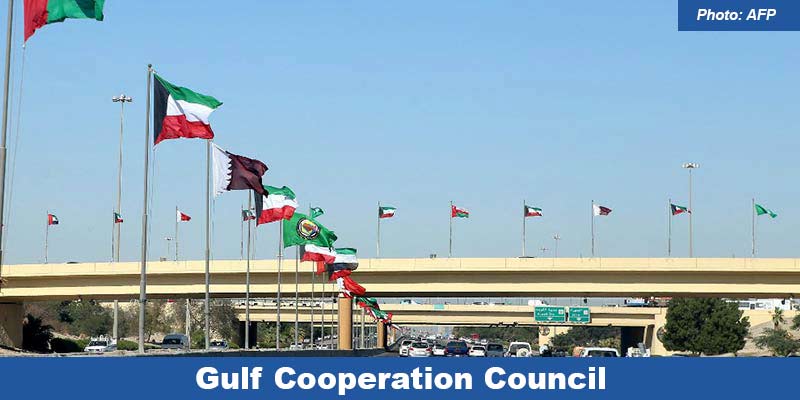
What is the Gulf Cooperation Council?
• The Gulf Cooperation Council (GCC) was established by an agreement concluded on May 25, 1981 in Riyadh among Bahrain, Kuwait, Oman, Qatar, Saudi Arabia and the UAE in view of their special relations, geographic proximity and similar political systems.
• GCC comprises some of the fastest growing economies in the world, mainly due to an increase in oil and natural gas revenues coupled with a building and investment boom backed by reserves, etc.
The GCC Charter states that the basic objectives are to:
i) Have coordination, integration and inter-connection between Member States in all fields.
ii) Strengthen ties between their peoples.
iii) Formulate similar regulations in various fields such as economy, finance, trade, customs, tourism, legislation, administration.
iv) Foster scientific and technical progress in industry, mining, agriculture, water and animal resources.
v) Establish scientific research centres.
vi) Set up joint ventures.
vii) Encourage cooperation of the private sector.
The structure of the GCC consists of:
• The Supreme Council which comprises the Heads of State of the six member countries.
• The Ministerial Council which comprises the foreign ministers of the six member countries.
• The Secretariat General which prepares reports, studies, accounts and budgets for the GCC.
• The Secretariat is located in Riyadh.
India and GCC
• The Gulf constitutes the “extended” neighborhood of India separated only by the Arabian Sea. India has a long standing historic deep-rooted relationship with GCC countries.
• The GCC countries are home to about 10 million strong Indian expatriate community and cultural and people-to-people ties between India and Gulf are bedrock of the bilateral relations.
• The GCC is a major trade and investment partner for India.
• The GCC’s substantial oil and gas reserves are of vital importance for India's energy security while defence and security cooperation with GCC has also been increasing.
• In recent years, the relationship between India and GCC countries has deepened in various spheres including trade, investment, energy, health, technology and cultural exchanges.
• A large Indian diaspora resides in the GCC region.
• Trade and investment between India and GCC continues to grow with total trade of $178.66 billion in FY 2025-26.
