
- India
- Sep 29
What are CELAC countries?
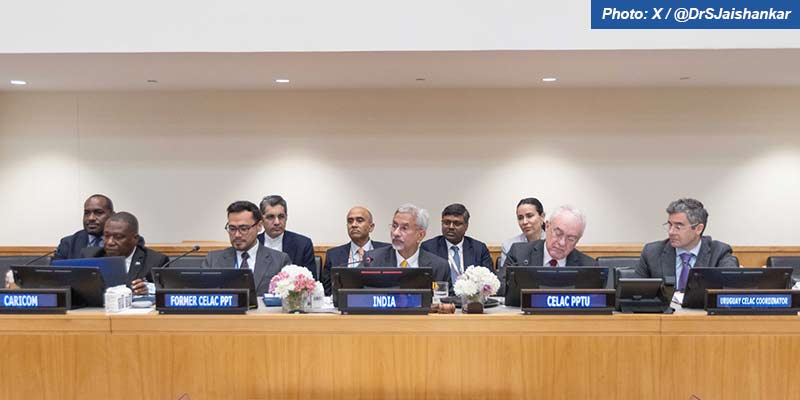
• Minister of External Affairs S. Jaishankar co-chaired the India-CELAC Expanded Troika Meeting on the sidelines of the 81st session of United Nations General Assembly (UNGA) in New York.
• CELAC is a regional forum that brings together all of Latin America and the Caribbean countries.
• The meeting saw strong participation of foreign ministers of 30 out of 33 CELAC members.
• They welcomed the landmark achievement of India-CELAC bilateral trade reaching $50 billion in 2025-26, while emphasizing the immense potential for further growth.
• The discussions further focused on strengthening India-CELAC cooperation, enhancing trade and development partnerships, and addressing global challenges through multilateralism.
What is CELAC?
• The Community of Latin American and Caribbean States (CELAC) is a regional political coordination mechanism, which gathers all 33 Latin American and Caribbean countries.
• The CELAC was initiated in February 2010 at the Rio Group-Caribbean Community Unity Summit.
• It was then formally established on December 3, 2011 with the signing of the Declaration of Caracas in Venezuela.
• CELAC is the successor of the Rio Group and the Latin American and Caribbean Summit on Integration and Development (CALC).
• As stipulated in the Caracas Declaration, CELAC pledged to promote the implementation of the action plans or work programmes of its two predecessor groups.
• The current membership of CELAC comprises 33 member states in the Americas that represents approximately 600 million people.
• CELAC members states are: Antigua and Barbuda, Argentina, Bahamas, Barbados, Belize, Bolivia, Brazil, Chile, Colombia, Costa Rica, Cuba, Dominica, Dominican Republic, Ecuador, El-Savador, Grenada, Guatemala, Guyana, Haiti, Honduras, Jamaica, Mexico, Nicaragua, Panama, Paraguay, Peru, Saint Lucia, Saint Kitts and Nevis, Saint Vincent and the Grenadines, Suriname, Trinidad and Tobago, Uruguay, and Venezuela.
• CELAC aims to unite all Latin American and Caribbean States in order to create a political, economic and sociocultural integration to advance social welfare, the quality of life, economic growth and promote independent and sustainable development.