
- India
- Oct 02
100 Years of UPSC - How was the UPSC formed?
• Prime Minister Narendra Modi participated in the centenary celebrations of the Union Public Service Commission (UPSC) at Bharat Mandapam, New Delhi on October 1.
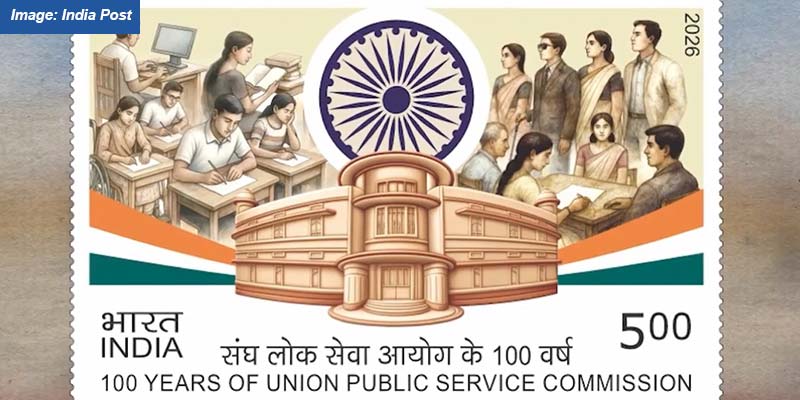
• PM Modi also released a commemorative coin, a stamp and a book titled ‘100 Landmark Judgements: Shaping the Policies of UPSC and Public Service Commissions in India’.
• The programme marked the culmination of year-long celebrations that began on October 1, 2025, commemorating 100 years of the establishment of the UPSC in 1926.
Key facts on UPSC:
• The Union Public Service Commission is an independent constitutional body whose powers and functions have been elaborately defined in Articles 315 to 323 of the Constitution.
• It is concerned with recruitment to the All India Services and Central Services — Group A and Group B — and advises the government, when consulted, on promotion and disciplinary matters.
• UPSC consists of a chairman and other members appointed by the President of India. The Constitution has not specified the strength of the Commission and left it to the discretion of the President.
• Usually the Commission consists of nine to eleven members, including the chairman.
• By the exercise of powers conferred by the proviso to Article 320 (3) of the Constitution the President has made the UPSC (Exemption from Consultation) Regulations, 1958 as amended from time to time, as respects the All India Services and also as respects other services and posts in connection with the affairs of the Union specifying the matters in which it shall not be necessary for the UPSC to be consulted.
Origin of UPSC
• The Government of India Act, 1919, enacted after the Montagu-Chelmsford Reforms, provided for a Public Service Commission.
• Section 96C of the Government of India Act, 1919 provided for the establishment in India of a Public Service Commission which should “discharge, in regard to recruitment and control of the Public Services in India, such functions as may be assigned thereto by rules made by the Secretary of State in Council”.
• After the passing of the Government of India Act, 1919, a prolonged correspondence took place between the Secretary of State, the government of India and local governments, regarding the functions and machinery of the body to be set up.
• In 1922, the ICS examination was held in India for the first time, at Allahabad, alongside London.
• The first Public Service Commission was established on October 1, 1926. The Commission consisted of four members in addition to the chairman, appointed by the Secretary of State in Council. Sir Ross Barker, a member of the Home Civil Service of the United Kingdom, was the first chairman. The Commission was built up by him and his successors on the model and in accordance with the traditions of the British Civil Service Commission.
• The Sections of the Government of India Act, 1935 relating to the Public Service Commissions were brought into force on April 1, 1937, and the then Public Service Commission at the Centre became the Federal Public Service Commission.
• On April 21, 1947, Sardar Vallabhbhai Patel addressed the first batch of civil service probationers there and described the civil services as the “steel frame of India”. The date is now observed every year as Civil Services Day.
• In 1947, H.K. Kripalani became the first Indian chairman of the Commission.
• The Constituent Assembly saw the need for giving a secure and autonomous status to Public Service Commission both at Federal and Provincial levels for ensuring unbiased recruitment to Civil Services as also for protection of service interests.
• After Independence, with the promulgation of the new Constitution for independent India on January 26, 1950, the ‘Federal Public Service Commission’ was accorded a Constitutional status and was renamed as ‘Union Public Service Commission’.
• The chairman and members of the Federal Public Service Commission became chairman and members of the Union Public Service Commission by virtue of Clause (1) of Article 378 of the Constitution.
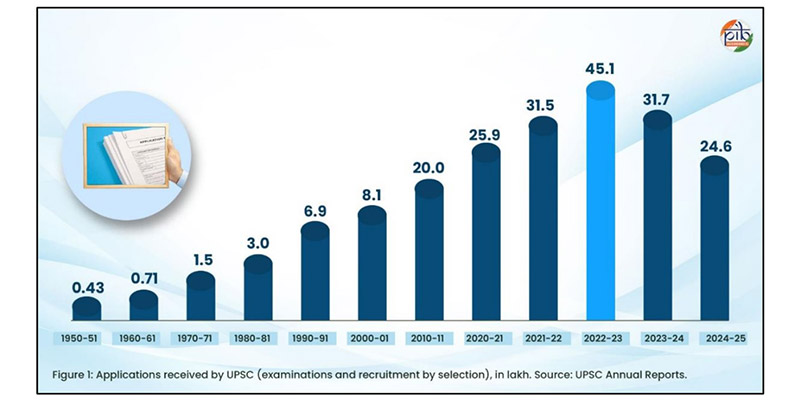
• The scale and complexity of the work handled by UPSC have increased significantly over the years, as applications across examinations and recruitment by selection grew from 42,727 in 1950-51 to a peak of 45,10,044 in 2022-23.
• In 1970-71, the Commission informed the government that the Personality Test could be conducted only in English. The position changed in 1980-81, and candidates may now answer in an Indian language with an interpreter provided by the Commission.
• The Commission is headed by chairman Ajay Kumar since May 15, 2025.
Functions of UPSC:
The functions of the Commission are prescribed in Article 320 of the Constitution.
These include:
a) Conduct of Examinations for appointment to the Services of the Union.
b) Direct recruitment by selection through interviews.
c) The Commission shall also be consulted in:
i) Appointment of officers on promotion / deputation / absorption.
ii) Framing and amendment of Recruitment Rules for various
Services and posts under the government of India and Union Territories.
iii) Disciplinary cases relating to different Civil Services.
iv) On any matter referred by the President of India.