
- India
- Oct 05
- Sreesha V.M
Captive-bred two Great Indian Bustards released into wild in Jaisalmer
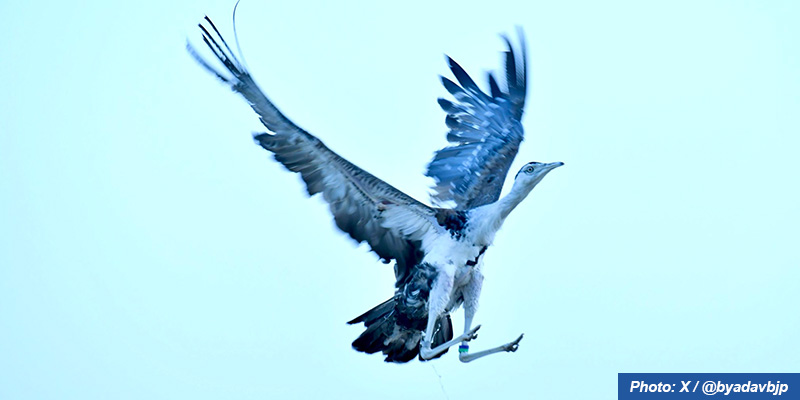
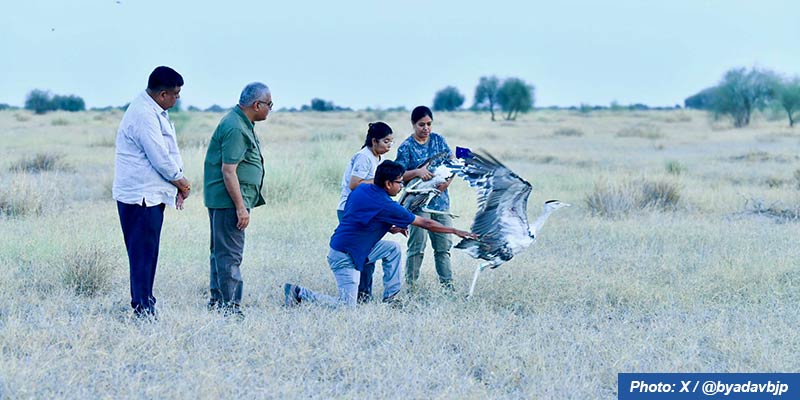
• Union Environment Minister Bhupender Yadav released two male Great Indian Bustards (GIBs) into the wild at Sam, in the Desert National Park, Jaisalmer, Rajasthan on October 4.
• The release marks an important transition in India’s GIB conservation programme from establishing a viable conservation-breeding population towards rewilding and augmenting the species in its natural habitat.
• Learnings from the release would be used to progressively refine the protocols for subsequent releases.
• The milestone was the outcome of nearly a decade of dedication by scientists, researchers, and ground staff to help the Great Indian Bustard, a critically endangered bird, reclaim the deserts of Rajasthan.
Bustard Recovery Programme
• The Bustard Recovery Programme is a collaborative initiative of the Ministry of Environment, Forest and Climate Change, Rajasthan Forest Department and the Wildlife Institute of India (WII), with technical collaboration from the International Fund for Houbara Conservation and funding support from National Compensatory Afforestation Fund Management and Planning Authority (CAMPA).
• The programme focuses on conservation breeding, habitat management, threat mitigation, habitat restoration and community engagement.
• The conservation programme is a collaborative initiative of the Union Environment Ministry, the Rajasthan Forest Department, and the Wildlife Institute of India (WII).
• Currently, the Great Indian Bustard facilities in Sam and Ramdevra house 97 birds, 40 of which originated from wild-laid eggs, and 57 have been bred in captivity.
• Of these, 86 birds are being maintained for captive reproduction, while 11 have been earmarked for release into the wild.
• Captive reproduction resulted in 24 live chicks in 2025 and 29 in 2026.
• Scientific interventions, including the novel ‘jumpstart’ approach, have also contributed to the species’ recovery. Under this approach, captive-laid eggs placed in wild nests were accepted by incubating females, resulting in the hatching of six chicks in Rajasthan and two in Gujarat.
Key facts on Great Indian Bustard:
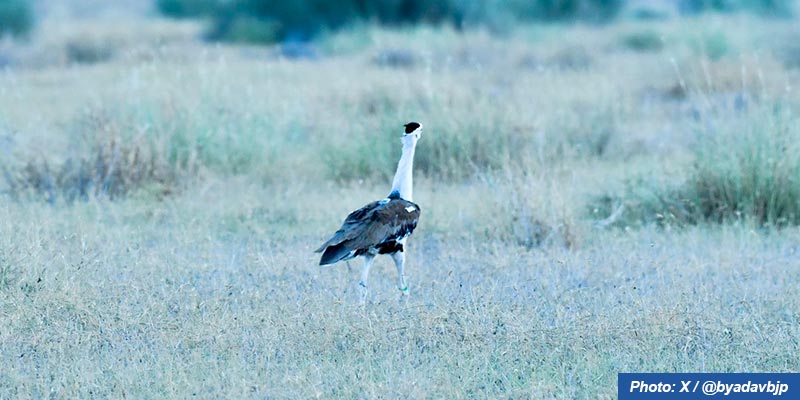
• The Great Indian Bustard (Ardeotis nigriceps) is a critically endangered species.
• They are found in localised grassland habitats and have been facing challenges of habitat degradation and anthropogenic factors.
• The decline in the population of the Great Indian Bustards is associated with a variety of factors such as loss of habitat, degradation of habitat quality, enhanced agriculture, and predation by feral and domesticated dogs, other wild carnivores and associated anthropogenic activities.
• The collision with the high tension power line and wind mills are also one of the reasons for mortality.
• Further, GIBs are also considered as slow breeders.
Threats due to power lines
• The Wildlife Institute of India (WII) in its Report “Power Line Mitigation, 2018” has stated that every year one lakh birds die due to collision with power lines.
• Overhead power lines are the biggest threat to the survival of the GIBs.
• The Report concluded that unless power line mortality is mitigated urgently, extinction of GIBs is certain.
• The Great Indian Bustard is one of the heaviest flying birds in the world, about a metre in height and wingspan of around seven feet.
• The Great Indian Bustard lacks frontal vision. Due to this, they cannot detect power lines ahead of them, from far. As they are heavy birds, they are unable to manoeuvre across power lines within close distances. Thus, they are vulnerable to collision with power lines.
• In case of low voltage lines, electrocution is often the cause of death due to smaller phase to phase separation distance.
Steps taken by govt for protection of GIBs
• The Great Indian Bustard is listed in Schedule-I of the Wild Life (Protection) Act, 1972, thereby, according it highest degree of legal protection from hunting.
• Important habitats of GIBs are designated as national parks/sanctuaries for their better protection.
• The species has been identified for conservation efforts under the component ‘Species Recovery Programme’ of the Centrally Sponsored Scheme (CSS)-Development of Wildlife Habitat.
• Financial and technical assistance is provided to state/Union Territory governments under the Centrally Sponsored Scheme of Development of Wildlife Habitat for providing better protection to Great Indian Bustard and its habitat.
• The Union Environment Ministry has taken up an initiative on conservation breeding of the Great Indian Bustard in collaboration with Rajasthan, Gujarat and Maharashtra forest departments and technical support from Wildlife Institute of India, Dehradun.
• Two conservation breeding centers have been established at Sam and Ramdevra in Jaisalmer district, Rajasthan.
• The programme has developed techniques for artificial hatching, chick rearing, bustard husbandry, and captive breeding. The GIB has been bred in captivity successfully under this programme.
• Great Indian Bustard has been included in the Appendix I of Convention on Migratory Species (CMS) on the basis of a proposal submitted by India.
(The author is a trainer for Civil Services aspirants.)