
- India
- Oct 12
UN human rights body voices concern over mass detentions in New Delhi
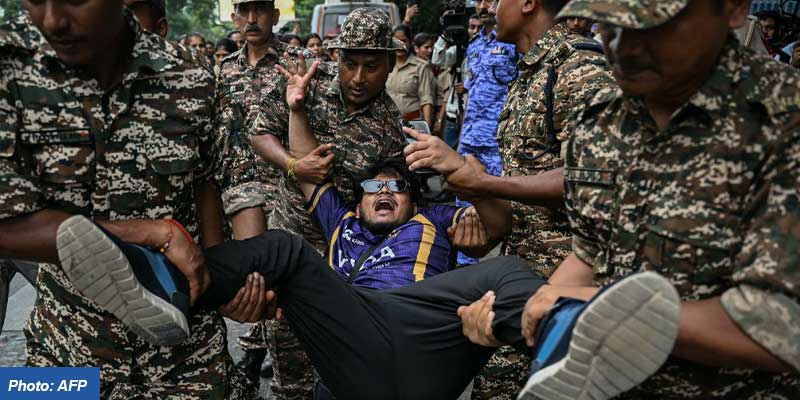
• The UN human rights office (OHCHR) voiced concern over mass detentions of demonstrators, protest leaders, civil society members, lawyers and journalists, before and during large-scale protests in New Delhi on October 10.
• The Indian authorities should ensure law enforcement forces exercise utmost restraint in response to peaceful protesters, consistent with the country’s democratic traditions and human rights obligations, it said.
What led to protests in New Delhi?
• The Cockroach Janta Party (CJP) and Opposition parties have been demanding the resignation of Chief Election Commissioner Gyanesh Kumar over alleged irregularities in the functioning of the Election Commission and the Special Intensive Revision (SIR) of electoral rolls.
Thousands detained in police crackdown
• Police refused permission for protests to take place at the planned venue — Jantar Mantar — in the national capital, and heavy security and road closures were reported.
• Waves of barricades lined the streets, with the deployment of over 30,000 police and paramilitary personnel, the closure of 45 metro stations and intensive checks at the city’s border points, railway stations, bus terminals, hotels and other sensitive locations.
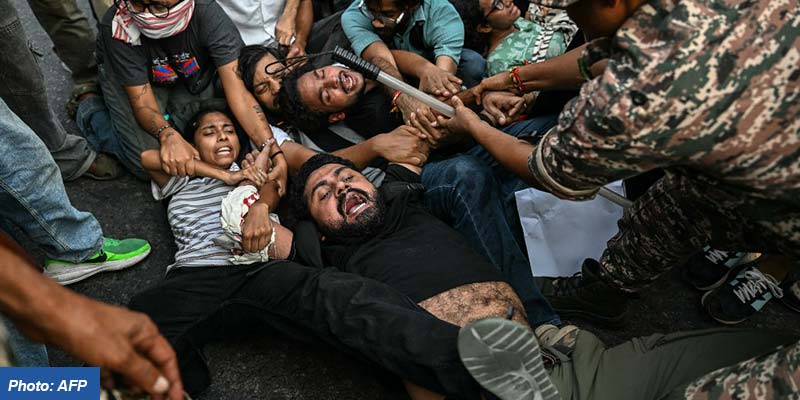
• The national capital was turned into a fortress as police launched a sweeping crackdown.
• Police detained CJP founder Abhijeet Dipke and other leaders from inside the aircraft as soon as their flight from Mumbai landed in New Delhi.
• Before the detention, police personnel told the CJP leaders that they did not have permission to hold their protest at Jantar Mantar.
• Police detained thousands of protesters.
• Several opposition leaders, including former Chief Ministers Arvind Kejriwal, Mamata Banerjee, Pinarayi Vijayan and Manik Sarkar, were also detained while attempting to join the protest.
How India responded to OHCHR’s remarks?
• The Ministry of External Affairs (MEA) rejected the UN human rights agency’s remarks, describing them as “unwarranted” and an “unacceptable interference” in the country’s internal affairs.
• It also noted that the OHCHR has an approach of extreme selectivity when it comes to public positions. Violent responses to protests in our neighbourhood have gone uncommented, as indeed have law enforcement actions in its own vicinity, the MEA said.
• Such double standards only erode the credibility of its standing and contribute to the loss of faith in multilateralism, it added.
The Office of the UN High Commissioner for Human Rights (OHCHR)
• The Office of the High Commissioner for Human Rights (UN Human Rights) is the leading UN entity on human rights.
• The UN General Assembly established the OHCHR in December 1993.
The mission of the OHCHR is:
i) To work for the protection of all human rights for all people.
ii) To help empower people to realise their rights.
iii) To assist those responsible for upholding such rights in ensuring that they are implemented.
• The High Commissioner for Human Rights is the principal human rights official of the United Nations.
• The United Nations High Commissioner for Human Rights is accountable to the Secretary-General and is responsible for all the activities of OHCHR, as well as for its administration.
• The High Commissioner is appointed by the Secretary-General of the UN and approved by the General Assembly, with due regard to geographical rotation for a fixed term of four years with a possibility of one renewal for another fixed term of four years.
• Volker Turk of Austria is the current High Commissioner for Human Rights, and took up his duties in October 2022.