
- India
- Oct 16
DoT mandates caller name display service on 4G & 5G networks from November 1
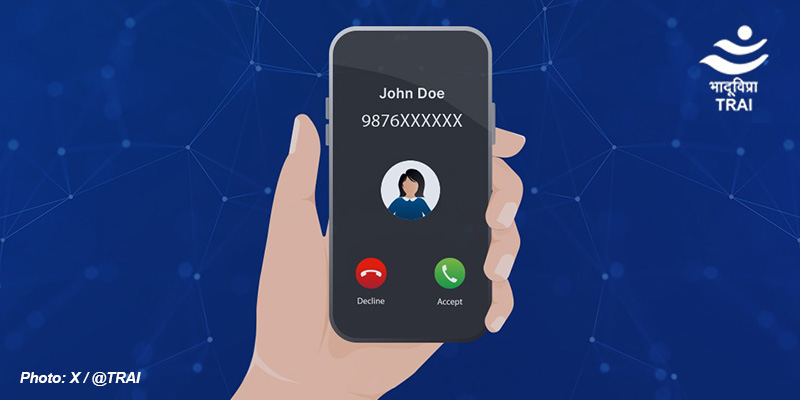
• The Department of Telecom (DoT) has mandated that all networks display callers’ original names on 4G and 5G mobile networks from November 1, according to an official circular.
• The DoT said telecom operators have carried out trials to introduce Calling Name Presentation (CNAP) on 4G and higher-generation technologies.
• The technology has been introduced in the network to prevent online frauds.
Calling Name Presentation (CNAP) Service
• CNAP is the supplementary service which enables the called party to receive the information of the calling party. This supplementary service provides the ability to indicate the name information of the calling party to the called party at call set-up time for all incoming calls.
What will be displayed during the call?
• The incoming call receiver will see names saved in the contact list, followed by the name identified by the telecom operator where the caller is registered.
• The caller identity will be shown in case of a domestic call, while a phone call from overseas will be labelled as an international call.
• For bulk business connections, the entity’s preferred name will be shown.
• The preferred name can be a trademark registered in the user’s name, as per records of the concerned government department, or the user’s trade name as registered on the goods and services portal.
• For new connections, telecom operators must record the preferred name of bulk subscribers in the customer application form, subscriber data record, and supporting documents.
• Names of callers who have availed Calling Line Identification Restriction (CLIR) facility as per existing rule will not be displayed as part of CNAP service.
• Introduction of calling name presentation service in wireless terrestrial networks established using 2G and 3G technologies and in public switched telephone networks shall be considered separately, after examination of the matter.
Why there is a need for CNAP service?
• The last two decades have witnessed a remarkable growth in the telecommunication sector in the country.
• At present, all access service providers in India provide Calling Line Identification Presentation (CLIP) supplementary service, as a part of their bouquet of services to telephone consumers.
• When a telephone consumer receives an incoming call, the telephone number of the calling party is displayed on the called party’s telephone, through the CLIP service.
• The telephone consumers require that they should be able to correctly identify the calling party.
• The CLIP service does not adequately meet this requirement as this service presents only the telephone number of the calling party.
• Apparently, the said requirement may be met through a name presentation facility where the name identity of the calling party is displayed on the called party’s telephone.
• Telephone consumers, at various fora, have raised a concern that in absence of the calling party name presentation facility, they prefer not to attend calls from unknown telephone numbers, as most of such calls are unsolicited commercial communications (UCCs) from un-registered telemarketers. As a result, even genuine telephone calls go unanswered.
• Telephone consumers have also raised their concern in respect of robocalls, spam calls, and fraudulent calls.
• Robocalls are calls made automatically by IT-enabled systems mainly to financially dupe telephone consumers.
• Spam calls are unsolicited marketing calls from personal mobile connections, bypassing the do-not-disturb (DND) feature, and targeting many telephone consumers.
• Through fraudulent calls, certain individuals attempt to obtain details of bank account/ onetime-password (OTP) with an aim to defraud consumers.
• At present, smartphone users make use of native smartphone tools and third-party apps to identify the calling party name and mark spam calls.