
- India
- Oct 16
Govt approves accession to Southern Indian Ocean Fisheries Agreement (SIOFA)
• The central government has approved accession to the Southern Indian Ocean Fisheries Agreement (SIOFA).
• It represents a strategic milestone that reinforces India’s position in global fisheries governance.
• It would provide a regional framework to expand India’s fishing fleet into international waters.
What is SIOFA?
• The Southern Indian Ocean Fisheries Agreement (SIOFA) was signed in Rome on July 7, 2006 and entered into force in June 2012.
• It is a regional fisheries management organisation.
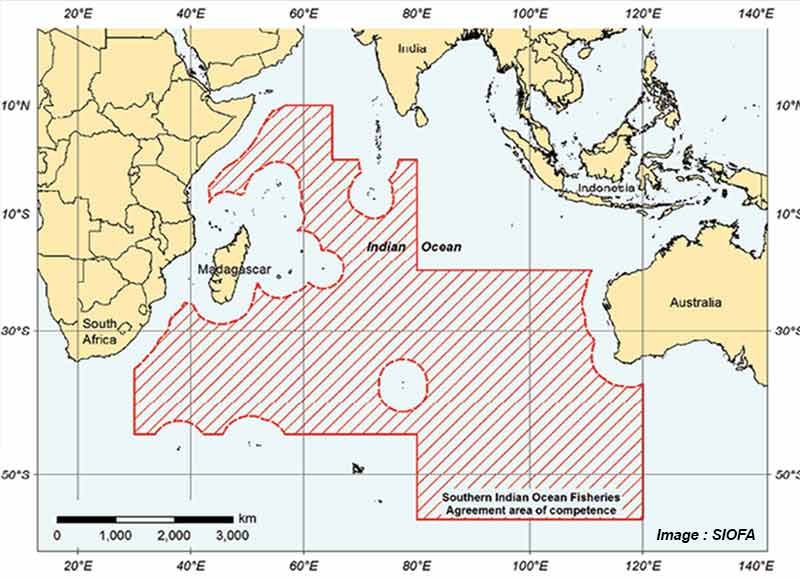
• It was established to manage fishery resources on high-sea areas in the southern part of the Indian Ocean.
• The SIOFA Agreement covers fishery resources including fish, molluscs, crustaceans and other sedentary species within the area, but excluding highly migratory species (Annex I of UNCLOS) and sedentary species subject to the fishery jurisdiction of coastal states (Article 77(4) of UNCLOS).
Objectives of SIOFA are:
i) To ensure the long-term conservation and sustainable use of the fishery resources in the Area through cooperation among the Contracting Parties.
ii) To promote the sustainable development of fisheries in the Area, taking into account the needs of developing States bordering the Area that are Contracting Parties to this Agreement and in particular the least developed among them and small-island developing States.
Members of SIOFA:
• SIOFA has ten Contracting Parties: Australia, China, the Cook Islands, the European Union, France, Japan, South Korea, Mauritius, the Seychelles and Thailand.
• Two cooperating non-Contracting Parties: Comoros and India.
• Kenya, Madagascar, Mozambique and New Zealand are signatories to this Agreement but have not ratified it.
• The headquarters is situated in Le Port, Reunion Island.
How India will benefit with SIOFA framework?
• There are two major Regional Fisheries Management Organisations (RFMOs) in the Indian Ocean:
1) Indian Ocean Tuna Commission (IOTC)
2) Southern Indian Ocean Fisheries Agreement (SIOFA).
• Currently, India, as a Cooperating Non-Contracting Party (CNCP) to the SIOFA, has limited participation in decision-making, including in key bodies such as the Scientific Committee and the Compliance Committee.
• Accession as a Contracting Party would enable India to participate fully in these bodies and provide access to scientific data, research programmes, and stock assessments.
• It will open up new fishing opportunities for the Indian fishers and entrepreneurs.
• India will be positioned to safeguard its strategic interests, broaden economic opportunities, and establish legitimate rights for the sustainable harvesting of high-value marine resources under the SIOFA framework.
• It affirms a recognised presence on the high seas and advances India’s Blue Economy in alignment with national economic, scientific, and strategic priorities.
• Indian-flagged fishing vessels and enterprises will be able to undertake authorised fishing of squids, toothfish, alfonsino, and other non-migratory fish stocks within SIOFA’s jurisdiction.
• India can collaborate with other Cooperating Parties to participate in the scientific assessments of the resources covered under the Agreement, and prevention of illegal, unreported and unregulated (IUU) fishing.
• Accession will also advance India’s strategic regional priorities and strengthen national coastal security through active involvement in the High Seas Boarding and Inspection (HSBI) Scheme, which has been adopted and is set to be implemented under the SIOFA.