
- India
- Oct 16
President Murmu accepts resignation of Union Minister L. Murugan
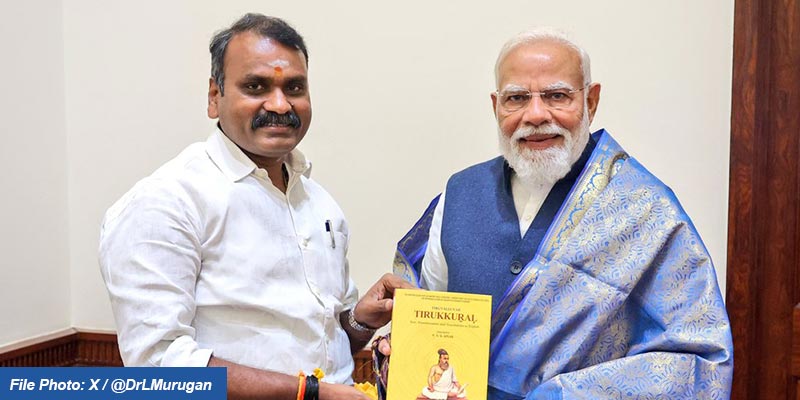
• President Droupadi Murmu accepted the resignation of Union minister L. Murugan on October 15.
• Murugan resigned as the Minister of State for Information and Broadcasting and Parliamentary Affairs on October 13.
• The President, as advised by the Prime Minister, accepted the resignation of Murugan from the Union Council of Ministers, with immediate effect, under Article 75(2) of the Constitution of India.
• This was the third resignation of a Minister of State (MoS) from the Council of Ministers after George Kurian and Ravneet Singh Bittu, who quit in June and July respectively after they were not renominated for Rajya Sabha elections by the BJP.
• Murugan has been a member of the Rajya Sabha since September 2021 and was re-elected to the Upper House in April 2024 from Madhya Pradesh. His tenure ends in April 2030.
The Union Executive
• The Union executive consists of the President, the Vice President and the Council of Ministers with the Prime Minister as the head to aid and advise the President.
• The President of India is the constitutional head of executive of the Union.
Council of Ministers
• Articles 74 and 75 deal with the Council of Ministers.
• Article 74(1) states that: “There shall be a Council of Ministers with the Prime Minister at the head to aid and advise the President who shall, in the exercise of his functions, act in accordance with such advice.”
• Article 75(1) states that: “The Prime Minister shall be appointed by the President and the other Ministers shall be appointed by the President on the advice of the Prime Minister.”
• The Prime Minister decides who will be the ministers in the Council of Ministers. The Prime Minister allocates ranks and portfolios to the ministers.
• The Council of Ministers comprises ministers who are members of Cabinet, Ministers of State (independent charge), Ministers of State and Deputy Ministers.
• Depending upon the seniority and political importance, the ministers are given the ranks of Cabinet Minister, minister of State and deputy minister.
• Cabinet Ministers hold high-profile portfolios. It is these ministers who constitute the Cabinet, which has been described as “a wheel within a wheel”.
• The total number of ministers, including the Prime Minister, in the Council of Ministers shall not exceed 15 per cent of the total number of members of the Lok Sabha.
• Before a minister enters upon his office, the President shall administer to him the oaths of office and of secrecy according to the forms set out for the purpose in the Third Schedule.
• The ministers shall hold office during the pleasure of the President.
• The salaries and allowances of Ministers shall be such as Parliament may from time to time by law determine and, until Parliament so determines, shall be as specified in the Second Schedule.
• A minister who for any period of six consecutive months is not a member of either House of Parliament shall at the expiration of that period cease to be a minister.
• The Prime Minister presides over the meeting of the Council of Ministers.
• It is the duty of the Prime Minister to communicate to the President all decisions of the Council of Ministers relating to administration of affairs of the Union and proposals for legislation and information relating to them.
Collective responsibility
• The Council of Ministers is collectively responsible to the House of the People (Lok Sabha).
• Collective responsibility is based on the principle of the solidarity of the Cabinet. It implies that a vote of no confidence even against a single minister leads to the resignation of the entire Council of Ministers. It also indicates that if a minister does not agree with a policy or decision of the Cabinet, he or she must either accept the decision or resign. It is binding on all ministers to pursue or agree to a policy for which there is collective responsibility.