
- India
- Oct 23
- Sreesha V.M
India, Poland agree to double bilateral trade by 2030
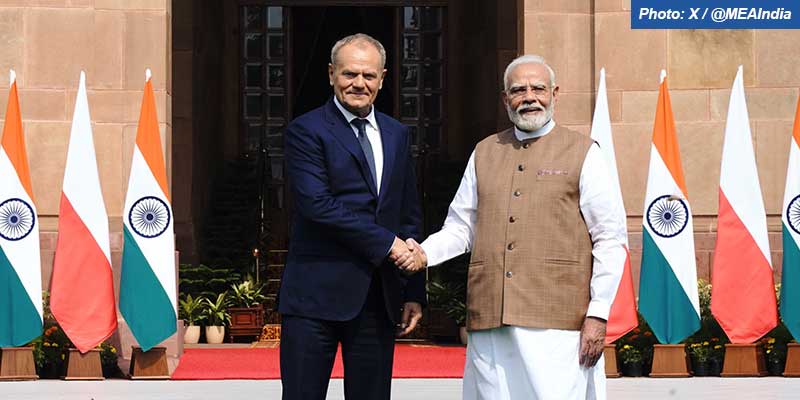
• Polish Prime Minister Donald Tusk paid an official visit to India from October 21 to 23.
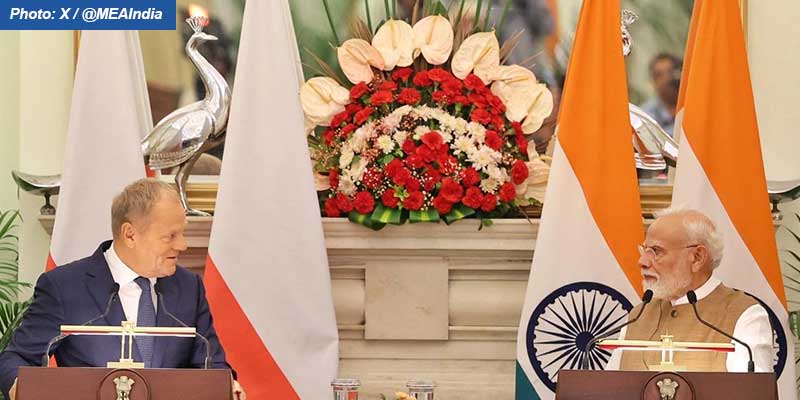
• Prime Minister Narendra Modi and his Polish counterpart Tusk held discussions on bilateral, regional and global issues of mutual interest.
Highlights of the meeting:
• In August 2024, the bilateral relationship between the both countries was elevated to a Strategic Partnership and the India-Poland Action Plan for 2024-2028 was adopted.
• The leaders endorsed the mid-term review of the Action Plan.
• They set the target of doubling bilateral trade by 2030.
• PM Modi invited Polish companies to expand their investments and operations in India and to benefit from India’s large market, skilled workforce and growing manufacturing and innovation ecosystem.
• India welcomed Poland’s announcement of joining the Coalition for Disaster Resilient Infrastructure (CDRI).
• A Defence Industry Dialogue was proposed by the leaders to encourage the development of a forward-looking framework for defence industrial cooperation, including greater business-to-business engagement and, where mutually agreed, partnerships in technology, co-development, co-production and other forms of industrial collaboration.
• Both leaders called for the early adoption of the Comprehensive Convention on International Terrorism (CCIT) at the United Nations. They agreed to have a dialogue on counter-terrorism.
India-Poland Relations
• India and Poland share a long-standing friendly relationship, marked by high level political contacts and vibrant economic engagement.
• Diplomatic relations were established in 1954, leading to the opening of the Indian Embassy in Warsaw in 1957.
• India and Poland transitioned to hard currency trading arrangements that were sustained by rising levels of trade as both economies grew in size and heft.
• A cordial political relationship has emerged in the current century, particularly after Poland joined the European Union in 2004, and became India’s key economic partner in Central Europe.
• The total bilateral trade with Poland has witnessed an increase from $1.95 billion in 2013 to $6.36 billion in 2025.
• India’s export items include textiles, base metals and articles, products of chemical industry. machinery and mechanical appliances, electrical and electro-technical equipment, footwear, transport equipment, rubber and materials, articles of stone, ceramic products, glass, etc.
• India imports machinery and mechanical appliances, electrical and electro-technical equipment, mineral products, products of chemical industry, optical, photographic, measuring, checking instruments, etc.
• Indian investment in Poland has been steadily growing over the years and is now estimated at over $3 billion. Indian companies are partners in the development of Poland and have created a substantial number of jobs locally, especially Indian IT companies which have invested in Poland.
• There is a strong tradition of Indology studies in Poland, with Polish scholars having translated Sanskrit into Polish as early as in the 19th Century. Sanskrit was being studied at the 600-year-old Jagiellonian University in Krakow (the oldest in Poland) in 1860-61, with a Chair of Sanskrit having been established there in 1893. The Indology Department of the Oriental Institute at the University of Warsaw (established in 1932) is the biggest center for Indian studies in Central Europe.
• A monument, commemorating Jam Saheb Digvijaysinhji Ranjitsinhji Jadeja of Nawanagar, was unveiled in October 2014 at the Square of the Good Maharaja, Ochota District, Warsaw, Poland. Eight Polish primary and secondary schools are named after Jam Saheb, known as ‘Good Maharaja’ in Poland. The Maharaja had accepted more than 1,000 Polish refugees, mainly children, as they escaped the depredations of the Second World War in the 1940s. The surviving Polish children have formed an Association of Poles, which meets on an annual basis in one of the major Polish cities.
• Another plaque commemorating the Valivade-Kolhapur camp near the Monte Cassino War Memorial was inaugurated in November 2017 in Warsaw.
(The author is a trainer for Civil Services aspirants.)