
- India
- Oct 26
Ashoke Sen becomes first Indian physicist to receive Oskar Klein Medal
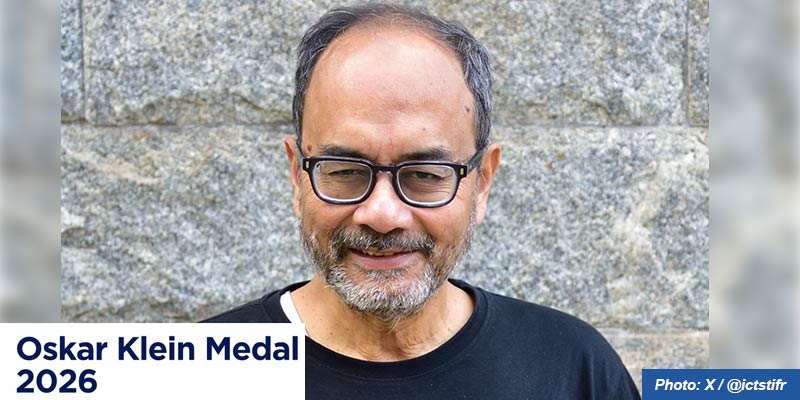
• Indian physicist Ashoke Sen has been awarded the 2026 Oskar Klein Medal, becoming the first Indian physicist to receive the honour.
• Sen, an ICTS-Infosys Madhava Chair professor at the International Centre for Theoretical Sciences (ICTS)-Tata Institute of Fundamental Research (TIFR), Bengaluru, is widely regarded as an architect of modern string theory.
• The theory postulates that the elementary constituents of matter are tiny one-dimensional, string-like objects instead of point particles.
• It thus tries to put forth a unifying description for matter and forces between them.
• Sen has been conferred the Padma Shri (2001) and Padma Bhushan (2013) for his contributions to science.
• He has also received the Breakthrough Prize in Fundamental Physics in 2012 for his contributions to establishing the unifying structure of string theory, and the Dirac Medal in 2014.
• His other honours include the Infosys Prize in Mathematical Sciences (2009), the Shanti Swarup Bhatnagar Prize (1994), the ICTP Prize (1989).
What is Oskar Klein Medal?
• The Oskar Klein Medal was established in 1988.
• It is named after Oskar Benjamin Klein, one of Sweden’s most renowned theoretical physicists.
• The medal is awarded annually by Stockholm University and the Nobel Committee for Physics of the Royal Swedish Academy of Sciences.
• The organising committee of the Oskar Klein Memorial Lectures every year invites a distinguished researcher to give a memorial lecture and to receive the Klein medal.
• Sen gave the lecture, titled ‘Gravity from strings and strings from gravity’, on October 22 at the AlbaNova University Centre in Stockholm.
• The talk described how string theory leads to a consistent quantum theory of gravity and addresses outstanding puzzles involving quantum theory of black holes.
• Past recipients of the Oskar Klein Medal include Kip Thorne in 2016, Peter Higgs in 2009, Stephen Hawking in 2003, and Nobel Prize recipients Hans E. Bethe in 1990, Steven Weinberg in 1989 and Chen Ning Yang in 1988.