
- India
- Oct 29
Cabinet approves Container Manufacturing Promotion Scheme
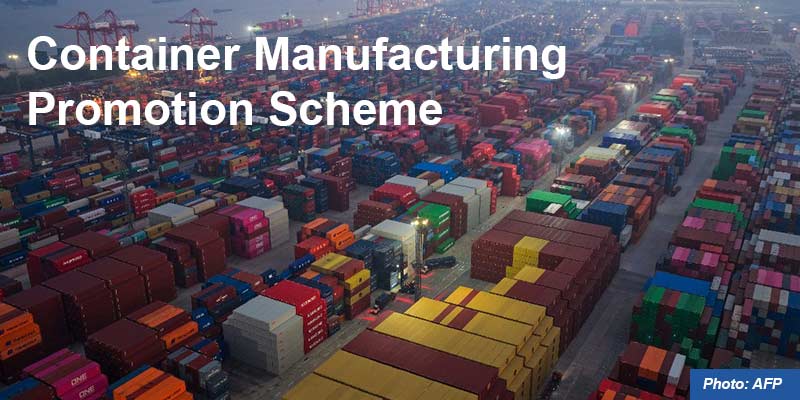
• The Union Cabinet, chaired by Prime Minister Narendra Modi, approved the Container Manufacturing Promotion Scheme (CMPS) with a budgetary outlay of Rs 10,000 crore.
• The programme was announced in the Union Budget 2026-27 to build a globally competitive container manufacturing ecosystem in India.
• The scheme will run from FY 2027-28 to FY 2039-40, with three years for setting up facilities and ten years of production support.
Significance of the scheme
• Shipping containers are standardised steel freight containers that transport cargo across ships, railways and road vehicles without unloading and repacking the goods during transit.
• Built as per ISO (International Organisation for Standardisation) specifications, they enable seamless intermodal transport and efficient global trade.
• The most common sizes are 20-foot and 40-foot containers, measured in Twenty-foot Equivalent Units (TEUs), the standard unit used to measure container capacity.
• India’s trade depends on containers, but almost all of them are made abroad.
• India’s container traffic is projected to grow from about 24 million TEUs in 2024 to 175 million TEUs by 2047 under the Maritime Amrit Kaal Vision, which makes home-grown capacity critical.
Highlights of the scheme:
• The scheme will support new factories as well as the expansion of existing units.
• It aims to lift India’s annual container manufacturing capacity around ten-fold, to 7.5 lakh TEUs, from about 70,000 TEUs today.
• The scheme is expected to create about 3,000 direct and more than 50,000 indirect jobs, in steel, components and logistics.
• It will also support ancillary industries such as corner castings, specialised steel, wooden frames and paints.
• The government estimates it will generate about Rs 75,000 crore of economic output by FY 2039-40, more than seven times the support provided.
The scheme offers:
i) Interest Subvention Assistance (Rs 859 crore): 3 per cent a year on eligible term loans for greenfield plants of at least 1,00,000 TEUs a year and brownfield expansions of at least 25,000 TEUs a year.
ii) Operational Expenditure Assistance (Rs 8,891 crore): Support for every container made to global shipping standards and sold by an eligible manufacturer, to bridge the cost gap with imports. To avail support, manufacturers must meet a minimum local-content requirement of 70 per cent through FY 2031-32. These criteria will further rise to 90 per cent from FY 2032-33 to strengthen the domestic supply chain.
iii) Testing and Certification (Rs 150 crore): Common facilities, such as dynamic longitudinal impact testing, to reduce dependence on overseas testing.
iv) Scheme management (Rs 100 crore): Administration, monitoring and capacity building.
v) Land at major ports: Leasing support at 25 per cent of the notified rate.
(The author is a trainer for Civil Services aspirants.)