
- India
- Oct 31
GSLV-F18 places navigation satellite NVS-03 into orbit
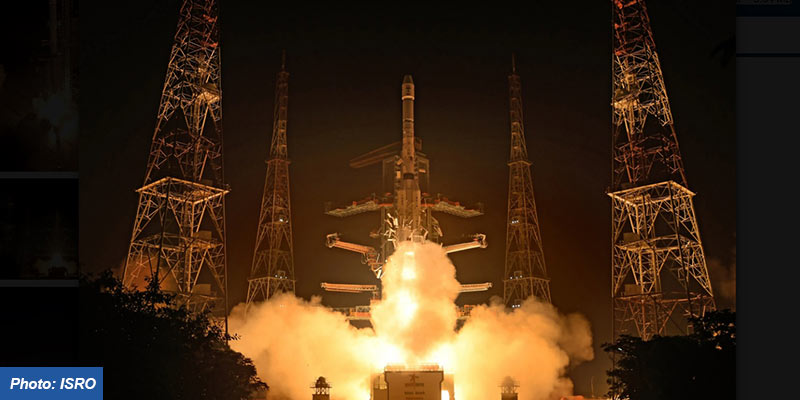
• ISRO successfully launched its navigation satellite NVS-03, which was placed into the designated injection orbit by a GSLV rocket.
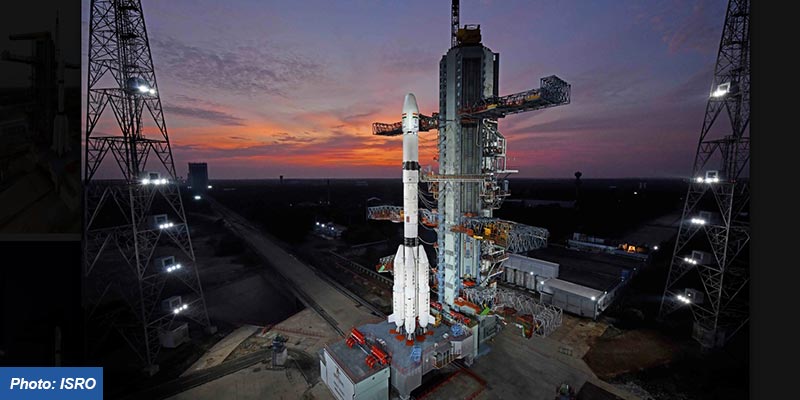
• The 50-metre-tall GSLV rocket carrying NVS-03 lifted off at the scheduled time of 11.51 pm from the second launch pad at Satish Dhawan Space Centre at Sriharikota in Andhra Pradesh on October 30.
• After a flight of about 18 minutes, which saw the successful performance of all three stages including the complex cryogenic upper stage, the primary payload got separated from the launch vehicle and was injected into a Geosynchronous Transfer Orbit (GTO).
• GSLV-F18 is the 20th flight of India’s Geosynchronous Satellite Launch Vehicle (GSLV).
• The successful deployment has restored India’s NavIC (Navigation with Indian Constellation) to its minimum operating configuration of four satellites.
• The NavIC constellation is an important component of the ‘One Nation, One Time’ project.
Highlights of NVS-03 satellite:
• NVS-01, the first of the second-generation satellites, was launched onboard GSLV-F12 on May 29, 2023. For the first time, an indigenous atomic clock was flown in NVS-01.
• The NVS-02 satellite was launched on January 29, 2025. But, it failed to reach the intended orbit due to a pyro valve signal loss.
• NVS-03 is the third satellite in the next generation navigation satellite system envisaged for providing continuity of navigation services for Indian Regional Navigation Satellite System (IRNSS) series.
• The satellite carries indigenous atomic clock, along with the procured atomic clocks.
• It will strengthen infrastructure for a robust Indian Standard Time (IST) with the government recently notifying the Legal Metrology (Indian Standard Time) Rules, 2026.
• It also includes L1 signal in addition to existing L5/S signals with coverage over India land mass and a region extending 1,500 km around Indian geopolitical boundary.
• ISRO plans to launch NVS-04 in five months, and NVS-05 in 10 months to further bolster the constellation.
What is NavIC?
• It provides independent access to Position, Navigation, Timing (PNT) services to users in India as well as the region extending up to 1,500 km from its boundary, which is its primary service area.
• NavIC is designed with a constellation of seven satellites and a network of ground stations operating 24x7.
• Three satellites of the constellation are placed in geostationary orbit, at 32.5°E, 83°E and 129.5°E respectively, and four satellites are placed in inclined geosynchronous orbit with equatorial crossing of 55°E and 111.75°E respectively, with inclination of 29° (two satellites in each plane).
• The ground network consists of a control centre, precise timing facility, range and integrity monitoring stations, two-way ranging stations, etc.
• NavIC offers two services: Standard Position Service (SPS) for civilian users and Restricted Service (RS) for strategic users.
• NavIC SPS signals are interoperable with the US global navigation satellite system signals, GPS, GLONASS (Russia), Galileo (European Union) and BeiDou (China).
Some applications of NavIC are:
i) Transportation (terrestrial, aerial and marine)
ii) Location based services
iii) Personal mobility
iv) Resource monitoring
v) Surveying and geodesy
vi) Scientific research
vii) Time dissemination and synchronisation
viii) Safety-of-life alert dissemination.
IRNSS series of satellites
• IRNSS-1A, the first satellite in the Indian Regional Navigation Satellite System (IRNSS), was launched in July 2013.
• IRNSS-1B navigation satellite was launched on April 4, 2014.
• IRNSS-1C was launched on October 16, 2014.
• IRNSS-1D was launched on March 28, 2015.
• IRNSS-1E, the fifth navigation satellite of IRNSS, was launched on January 20, 2016.
• IRNSS-1F was launched on March 10, 2016.
• IRNSS-1G was launched on April 28, 2016.
• IRNSS-1H was launched on August 31, 2017. It was unsuccessful because the rocket’s protective heat shield (payload fairing) failed to separate during the fourth stage.
• IRNSS-1I was launched on April 12, 2018 to replace IRNSS-1A.
• Before the launch of NVS-03, the NavIC constellation had three satellites for providing PNT services — IRNSS-1B, IRNSS-1I and NVS-01.
• To provide basic positioning service, a minimum of four operational satellites are required in orbit.