
- India
- Nov 18
- Sreesha V.M
Quad leaders endorse cybersecurity cooperation, AI accelerator
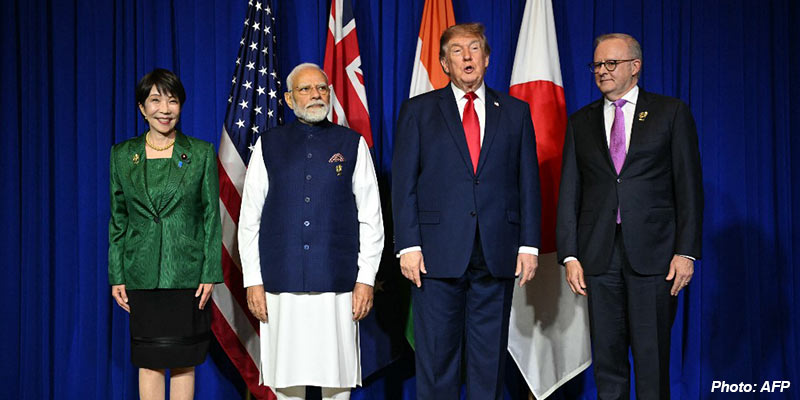
• The seventh Quad Leaders’ Summit was held in Manila on November 17.
• The Quad summit was attended by Prime Minister Narendra Modi, US President Donald Trump, Australian Prime Minister Anthony Albanese and Japanese Prime Minister Sanae Takaichi.
• This year marks nearly a decade since the Quad was revived and the tenth anniversary of the vision of a Free and Open Indo-Pacific, first articulated by the late Prime Minister Abe Shinzo of Japan in 2016.
What is Quad?
• The Quad, or the Quadrilateral Security Dialogue, is an informal grouping of four countries — Australia, India, Japan and the United States.
• It is a diplomatic partnership of four countries committed to promoting stability, resilience and prosperity in the Indo-Pacific.
• The four countries came together 20 years ago to extend assistance in response to the 2004 Indian Ocean earthquake and tsunami, and that coalition subsequently took form of the Quad.
• The 2004 tsunami was one of the worst disasters in history, claiming the lives of nearly a quarter million people and displacing 1.7 million across 14 countries.
• The four countries contributed over 40,000 emergency responders, working with other partners across the Indo-Pacific region to support millions of people affected by the catastrophe.
• The Quad has since become a leading regional partnership dedicated to advancing a common vision of a free and open Indo-Pacific through practical cooperation on diverse 21st-century challenges.
• The foreign ministers of the four countries held their first meeting under the Quad framework in New York in September 2019.
• The first Leaders’ Summit of the Quad was held virtually in March 2021.
• The Quad recognises that international law, peace, and security in the maritime domain underpins the development and prosperity of the Indo-Pacific.
• The countries are determined to deepen engagement with regional partners, including through capacity-building and technical assistance, to strengthen maritime domain awareness, protect their ability to develop offshore resources, consistent with the UN Convention on the Law of the Sea (UNCLOS).
• The Quad is exchanging information on ever-evolving threats and working with Indo-Pacific countries, and in multilateral fora, to counter all forms of terrorism and violent extremism.
• Quad partners champion the free, open, and inclusive rules-based order, rooted in international law, that protects the sovereignty and territorial integrity of regional countries.
• The Quad has been focusing on cooperation in areas such as producing vaccines, connectivity projects, facilitating the mobility of students and looking at promoting startups and technology collaboration.
• The Quad countries now work together and with partners across the Indo-Pacific to address complex challenges — from fighting climate change, cancer and pandemics, to bolstering quality infrastructure, counter-terrorism efforts, critical and emerging technologies, and cybersecurity.
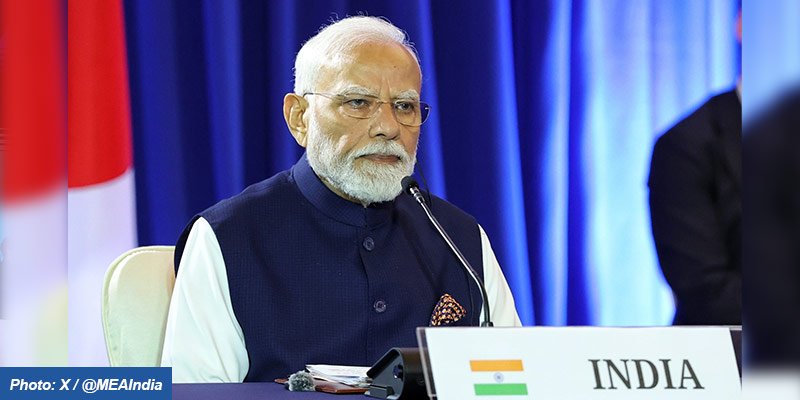
Highlights of 7th Quad Leaders’ Summit:
• The inaugural Quad Business Leaders’ Forum will be held in early 2027, bringing together business leaders, government officials, and policy experts from Quad countries to foster greater business ties across our private sectors, including the promotion of commercial deals and partnerships critical to the prosperity of the Indo-Pacific.
• The leaders affirmed the importance of the AI Accelerator. It is intended to coordinate and fund efforts to support trusted AI access, deployment, and technical assistance across the Indo-Pacific.
• They welcomed the Indo-Pacific Maritime Surveillance Collaboration, a new initiative to enhance information sharing and maritime domain awareness.
• They reviewed the progress under the Quad Partnership for Cable Connectivity and Resilience, which has expanded access to secure and trusted communications infrastructure across the Indo-Pacific.
• With the rapid increase in the number and scale of cyber incidents in the region they announced enhanced Quad Cybersecurity Cooperation, through which the countries plan to work together to achieve an open and secure cyberspace.
(The author is a trainer for Civil Services aspirants.)