
- India
- Nov 19
Bhupendra Yadav delivers India’s national statement at COP31
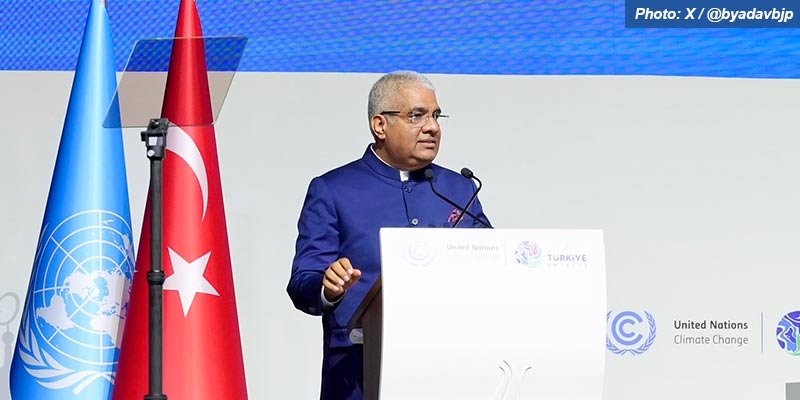
• Union Environment Minister Bhupendra Yadav delivered India’s national statement at the United Nations Climate Change Conference (COP31) in Antalya, Turkey on November 18.
• He called for climate action rooted in equity, climate justice and the principle of Common but Differentiated Responsibilities and Respective Capabilities (CBDR-RC).
• The 2015 Paris Agreement adheres to the principle of “common but differentiated responsibilities”, which means that while there is a duty on all countries to take climate action, the types of action they take will depend on their differing national circumstances.
• He stressed that COP decisions and their implementation must be firmly grounded in equity and CBDR-RC.
• He called for the Mitigation Work Programme (MWP) to remain facilitative and non-prescriptive, the Global Stocktake (GST) to continue serving as an instrument for informing Parties, and the Just Transition Mechanism (JTM) to be anchored in equity.
• The minister underlined that developing countries cannot be asked to choose between climate action and their legitimate right to development, decent living standards, health and education, adding that equitable access to the remaining carbon budget is non-negotiable.
High-level event on Global Stocktake-2
• Union Minister Yadav also addressed the high-level event on the Second Global Stocktake (GST-2) at UNFCCC COP31.
• The second Global Stocktake is essentially the Paris Agreement’s five-yearly reality check measuring whether national plans and promises add up to enough action to cut emissions, adapt to climate change and support countries most in need.
• The first Stocktake, completed in COP28 Dubai in 2023, helped spur agreements to triple renewable energy capacity, double gains in energy efficiency and accelerate the transition away from fossil fuels in energy systems.
• The GST-2 concludes in 2028.
• He called for GST-2 under the Paris Agreement to be an open, transparent and inclusive process, grounded in the best available science and equity, and delivering balanced outcomes across all aspects of climate action.
• The minister said that the GST must take a comprehensive 360-degree view of the Paris Agreement and its implementation, taking stock of both achievements and existing gaps.
• He emphasised that the process must be guided by the principles of equity, CBDR-RC, with developed countries taking the lead in the light of national circumstances.