
- India
- Nov 26
- Sreesha V.M
India, Nepal begin ‘Surya Kiran’ military exercise in Saljhandi
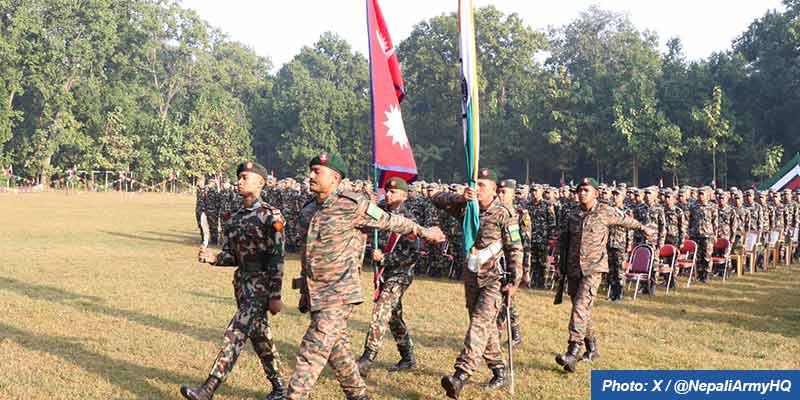
• The 20th edition of the annual bilateral exercise Surya Kiran between the Indian Army and the Nepali Army commenced at the Nepal Army Battle School in Saljhandi on November 25.
• It will conclude on December 8.
• The Nepal Army contingent, comprising an equal number of personnel, is being represented by troops from Shri Jawla Dal Battalion.
• The scope of the exercise includes joint tactical operations, heliborne operations, disaster response and medical training.
• Troops from both the armies will exchange operational experiences and best practices while refining tactics, techniques and procedures to enhance joint operational effectiveness.
• The previous edition of the exercise was conducted at Pithoragarh, Uttarakhand in November 2025.
Defence cooperation between both countries
• The exchange of such high-level visits and continuation of tradition helps in strengthening relations between the two militaries and the two countries.
• The country shares a border of over 1,850 km with five Indian states — Sikkim, West Bengal, Bihar, Uttar Pradesh and Uttarakhand. Land-locked Nepal relies heavily on India for the transportation of goods and services.
• The India-Nepal Treaty of Peace and Friendship of 1950 forms the bedrock of the special relations that exist between India and Nepal. Nepalese citizens avail facilities and opportunities on par with Indian citizens in accordance with the provisions of the Treaty.
• Nearly 8 million Nepalese citizens live and work in India.
• India and Nepal have wide-ranging cooperation in the defence sector. India has been assisting the Nepal Army (NA) in its modernisation by supplying equipment and providing training.
• The ‘Indo-Nepal Battalion-level Joint Military Exercise Surya Kiran’ is conducted alternately in India and in Nepal.
• The Gorkha regiments of the Indian Army are raised partly by recruitment from hill districts of Nepal. Currently, about 32,000 Gorkha soldiers from Nepal are serving in the Indian Army.
• India and Nepal cooperate closely in areas such as countering narcotics, cross-border crimes, money laundering, etc, apart from strengthening interaction in training and capacity building in areas related to security matters.
• There are several bilateral mechanisms for discussing cooperation on security matters including border security.
• There is regular and mutually beneficial engagement between the law enforcement authorities of both sides on such issues.
• The signing of the agreement on Mutual Legal Assistance in Criminal Matters (MLAA) between India and Nepal in February 2026 further enhances the effectiveness of investigation, prosecution and judicial proceedings in both countries for the prevention of cross-border crimes.
(The author is a trainer for Civil Services aspirants.)