
- World
- Feb 23
Israel’s maiden moon mission takes off
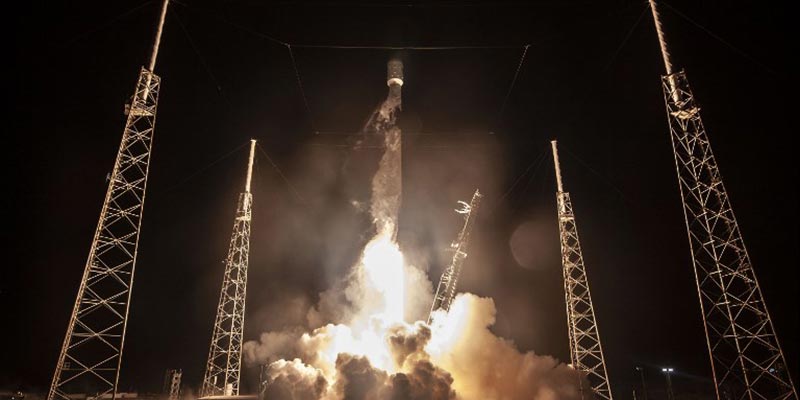
A rocket took off from Cape Canaveral in Florida carrying Israel’s Beresheet spacecraft, aiming to make history as the first private-sector landing on the Moon. It is also a first-of-a-kind mission from the Jewish country.
The 585 kg Beresheet, which means Genesis in Hebrew, lifted off at 8:45 pm on February 22 atop a Falcon 9 rocket from the private US-based SpaceX company of entrepreneur Elon Musk. Take-off was followed live back in Israel, with Prime Minister Benjamin Netanyahu watching alongside engineers from the control centre of the Israeli Aerospace Industries (IAI). The rocket also contains an Indonesian satellite and a satellite of the US Air Force Research Laboratory.
The Israeli craft has been placed in Earth orbit, from where it will use its own engine to undertake a seven-week trip to reach the Moon and touch down on April 11 in a large plain. The unmanned mission is part of renewed global interest in the moon.
Entrepreneurs, not government space agencies, financed the mission, which was initially projected at $10 million but eventually grew to $100 million. It was designed by SpaceIL, a non-profit organisation. Other partners are Israel’s space agency IAI and the science and technology ministry.
Beresheet will end up putting about 6.5 million km on its odometer when all is said and done. That is more than any other moon-landing mission. Beresheet will take seven weeks to reach the moon’s orbit. China’s Chang’e 4 farside lander reached lunar orbit just 5 days after its December 7 liftoff. This is because the 1.5-metre Beresheet cannot take a direct path to the moon, project team members said, because the lander shared a rocket ride with two other payloads.
“This is Uber-style space exploration,” SpaceIL co-founder Yonatan Winetraub said during a pre-launch news conference.
So far, only Russia, the US and China have made the 384,000-km journey and landed spacecraft on the moon. China’s Chang’e 4 made the first-ever soft landing on the far side of the moon on January 3, after a probe sent by Beijing made a lunar landing elsewhere in 2013. Americans are the only ones to have walked on the lunar surface, but have not been there since 1972.
For Israel, the landing itself is the main mission, but the spacecraft also carries a scientific instrument to measure the lunar magnetic field, which will help understanding of the moon’s formation. After its initial boost from the Falcon 9, the Beresheet’s British engine will have to make several ignitions to place the spacecraft on the correct trajectory to the moon. When it arrives, its landing gear must cushion the descent onto the lunar surface to prevent Beresheet from crashing.
Beresheet carries a “time capsule” loaded with digital files containing a Bible, children’s drawings, Israeli songs, memories of a Holocaust survivor and the blue-and-white Israeli flag.
At a cost of $100 million, “this is the lowest-budget spacecraft to ever undertake such a mission. The superpowers who managed to land a spacecraft on the moon have spent hundreds of millions of dollars in government funding”, the IAI said.
After China, and now Israel, India hopes to become the fifth lunar country in the spring with its Chandrayaan-2 mission. It aims to put a craft with a rover onto the moon’s surface to collect data.