
- World
- Mar 15
US-Russian crew finally make it to ISS
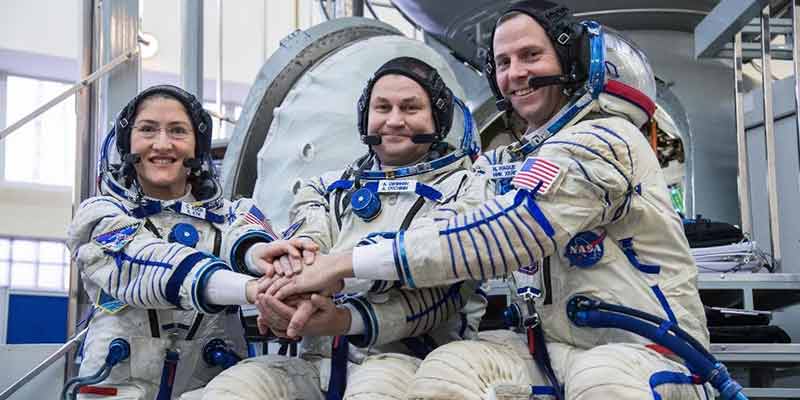
A Russian-American crew arrived at the International Space Station (ISS) on March 15, five months after a botched launch led to an emergency landing for two of the three astronauts.
This time, the Russian Soyuz rocket carrying NASA astronauts Nick Hague and Christina Koch along with Roscosmos’ Alexei Ovchinin lifted off precisely as planned from the Baikonur cosmodrome in Kazakhstan.
Six hours later, their capsule docked at the orbiting outpost.
On October 11, a Soyuz carrying Hague and Ovchinin failed two minutes into flight, activating a rescue system that allowed their capsule to land safely. That accident was the first aborted crew launch for the Russian space programme since 1983, when two Soviet cosmonauts safely jettisoned after a launchpad explosion.
Speaking at a pre-launch news conference, the astronauts said they trusted the rocket and fully believed in the success of their mission.
“I’m 100 per cent confident in the rocket and the spacecraft,” Hague said. “The events from October only helped to solidify that and boost confidence in the vehicle to do its job.”
The trio will join NASA’s Anne McClain, Roscosmos’ Oleg Kononenko and David Saint-Jacques of the Canadian Space Agency who are already on the ISS. They will conduct work on hundreds of experiments in biology, biotechnology, physical science and Earth science.
When one of the four strap-on boosters for their Soyuz failed to separate properly two minutes after their launch in October, Hague and Ovchinin were jettisoned from the rocket. Their rescue capsule plunged steeply back to Earth with its lights flashing and alarms screaming, subjecting the crew to seven times the force of gravity.
Hague emphasised before the launch this week that they were well-trained for the emergency.
“The nature of our profession is we spend 90-95 per cent of our time practicing what to do when things go wrong,” he said. “And so we spend all that time training, running through all those scenarios. And because we do train that way, like in October when things like that happened, we were ready to do what we need to do to come out successfully.”
The October failure was the first aborted launch for the Russian space programme in 35 years and only the third in history. Each time, the rocket’s automatic rescue system kept the crew safe.
A Russian investigation attributed October’s launch failure to a sensor that was damaged during the rocket’s final assembly. The next crew launch to the space station in December went on without a hitch.
Since the 2011 retirement of the US shuttle fleet, Russia’s Soyuz spacecraft have been the only vehicles that ferry crews to the ISS.
NASA is counting on SpaceX and Boeing to start launching astronauts later this year. The SpaceX Dragon returned from a six-day test flight to the ISS and could take astronauts there on its next flight as early as this summer.