
- World
- Jun 18
Bhutan calls for status quo on Doklam
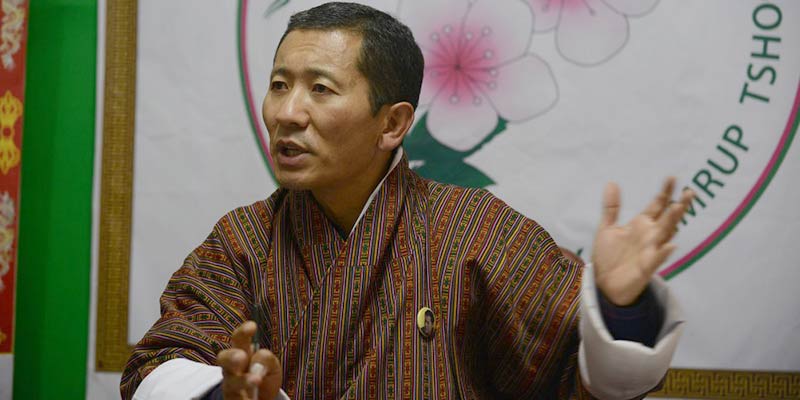
In comments that can be seen as a warning to China, Bhutan’s Prime Minister Lotay Tshering has said no side should do anything near the tri-junction point between India, China and Bhutan “unilaterally”. In an interview to The Hindu, Tshering said that as long as status quo was maintained, “there will be peace and tranquility in the region”.
The comments point to alignment in the views of India and Bhutan on the military standoff between India and China in 2017, which was triggered by China trying to build a road on Bhutan’s Doklam plateau. The move was first objected by Bhutan and then by India. Indian troops were then involved in a face-off with Chinese soldiers for 73 days before both sides withdrew.
Tshering’s comments also show that attempts by China to draw Bhutan closer into its sphere of influence have not worked. The remarks can also be seen as evidence of the fact that though some quarters in Bhutan had been advocating equidistance between India and China, Thimphu views India as its closest neighbour and security guarantor.
Background
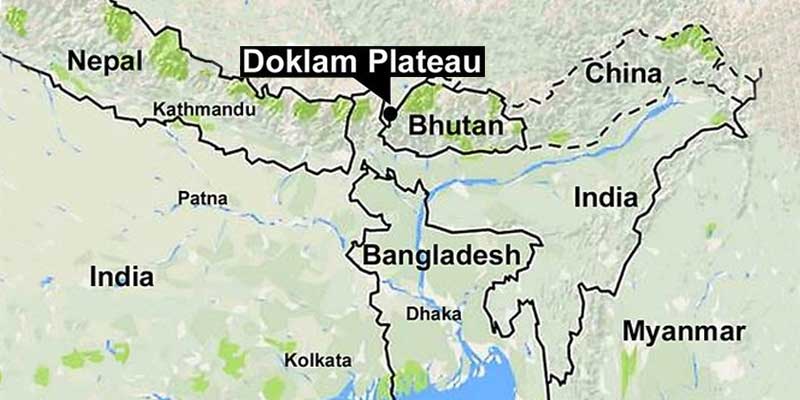
* Doklam is an area with a plateau and a valley lying between Tibet’s Chumbi valley to the north, Bhutan’s Ha valley to the east and India’s Sikkim state to the west.
* It has been depicted as part of Bhutan in the country’s maps since 1961, but it is also claimed by China.
* To date, the dispute has not been resolved despite several rounds of negotiations. The area is of strategic importance to Bhutan, China and India.
* The 2017 incident refers to the military border standoff between the Indian Army and the People’s Liberation Army (PLA) of China over Chinese construction of a road in Doklam near a tri-junction border area known as Donglang.
* On June 16, 2017, Chinese troops with construction vehicles and road-building equipment began extending an existing road southward in Doklam.
* On June 18, about 270 Indian troops crossed the Sikkim border into Doklam to stop Chinese troops from constructing the road.
* On August 28, both India and China announced that they had withdrawn all their troops from the face-off site in Doklam.
Why is Doklam significant?
* The presence of Indian soldiers in Doklam signified New Delhi’s commitment to Bhutan’s independence, a test of its willingness to take on Chinese bullying in the region and a security imperative - given that the defence of Doklam is virtually the defence of India, so close as it is to a vital choke point.
* The road construction would represent a significant change of status quo with serious security implications for India. India underlined that the two governments had agreed in 2012 that the tri-junction boundary points between India, China and third countries will be finalised in consultation with the countries concerned.
India’s policy options
In its efforts to engage China, India has followed a policy of appeasement. And its response to Beijing’s misadventures have been in the form of crisis management. To effectively cope with China’s hostile attitude, India needs to evolve a pragmatic China policy centred on core national interests.
* Firstly, given China’s policy of asymmetric coercion, India has no option but to narrow the existing Comprehensive National Power (CNP) gap between the two countries. Developing strategic partnerships, initiatives such as Indo-Pacific Economic Corridor, Act East Policy and counter-balancing strategies are steps in the right direction.
* Secondly, India’s national security policy needs clear articulation, based on a realistic threat assessment. Apex organisational structures require streamlining to telescope the decision-making process. The current format of military modernisation demands a holistic review.
* Thirdly, in an era of limited wars, a joint military doctrine is a sine qua non and tri service theatre commands are prerequisites for synergised application of the war-waging potential. In the prevailing scenario, facing the PLA’s Western Theatre Command are India’s seven Army and Air Force commands, which is a serious lacuna. In short engagements, the timely application of requisite combat power at the point of decision is critical. This calls for creating essential infrastructure on highest priority.
* Lastly, the border management mechanism needs to be revamped. A single nodal agency is required to coordinate the functions of various organs. Operational control astride the Line of Actual Control ought to rest with the Army. A well-calibrated response mechanism must be put in place, with disputed vulnerable areas effectively dominated and troops fully prepared to meet any eventuality. Paramilitary forces deployed for manning the borders require urgent upgrade to match the PLA’s Border Regiments.
While many seem to know China, few understand it. In a desperation to engage with Beijing, there is a tendency to lose sight of the bigger picture. Given the conflicting interests coupled with unresolved issues, relations between India and China are bound to be marked by contradictions, leading to frequent confrontations. However, through deft diplomacy, differences can be managed. While solutions to vexed problems may not be on the horizon, disputes turning into conflict can be avoided in the larger interest of both nations.
The Chinese are shrewd negotiators. So, New Delhi must firmly stand its ground and safeguard its strategic interests. To deal with China on an equal footing, India has to make pragmatic assessments, possess the courage to accept home truths and display audacity for taking bold decisions.