
- World
- Jun 19
70.8 mn people displaced globally: UN
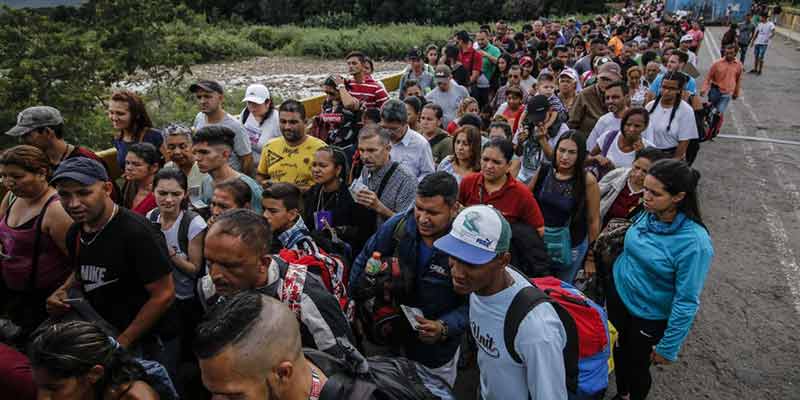
More than 70 million people were counted last year as displaced from their homes, a record that underestimates the real number of refugees and asylum seekers, the UN said.
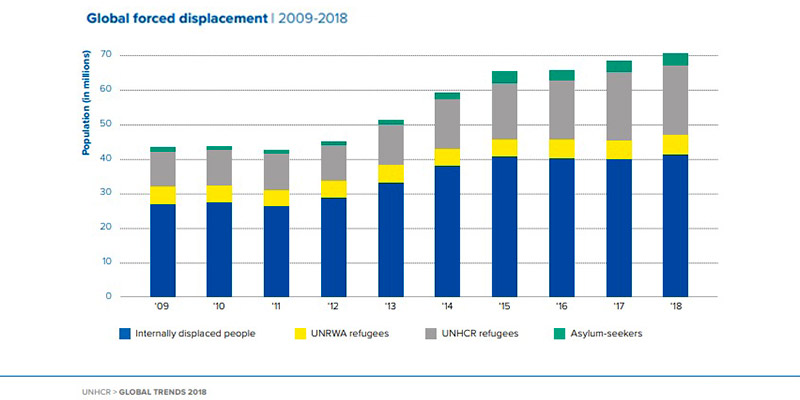
In its annual global trends report, the United Nations Refugee Agency (UNHCR) described the figure of 70.8 million at the end of 2018 as “conservative”, particularly because the number of people who fled Venezuela’s devastating crisis is undercounted. At the end of 2017, by comparison, 68.5 million people were counted as being forcibly displaced by violence or persecution.
The UNHCR attributed the increase partly to surging displacement in Ethiopia caused by inter-ethnic conflict, and in Venezuela, where thousands are fleeing every day amid an economic collapse that has triggered shortages of basic food and medicine.
The countries with the most internally displaced people - fleeing within their own countries - are Syria, wracked by conflict since 2011, and Colombia, plagued by decades of violence, said the UNHCR.
Overall, the number of displaced people in the world has doubled over the past 20 years and now exceeds the population of Thailand.
Three main categories
Within the 70.8 million figure in the Global Trends report are three main groups. The first is refugees, meaning people forced to flee their country because of conflict, war or persecution. In 2018, the number of refugees reached 25.9 million worldwide, 500,000 more than in 2017. Included in this total are 5.5 million Palestine refugees who are under the care of the UN Relief and Works Agency.
The second group is asylum seekers - people outside their country of origin and receiving international protection, but awaiting the outcome of their claim to refugee status. At the end of 2018, there were 3.5 million asylum seekers globally.
Among those newly displaced across borders (or newly registered), the vast majority remained close to home. Over half a million new refugee registrations and asylum applications originated from Syria in 2018, the majority in Turkey, representing both newly arriving individuals and those already in the country for a period of time prior to the time of registration.
Venezuelans accounted for the second largest flow of new international displacements in 2018, with 341,800 new asylum applications.
The third and biggest group, at 41.3 million, is people displaced to other areas within their own country, a category commonly referred to as Internally Displaced People or IDPs. Overall growth in displacement continued to exceed the rate at which solutions are being found for people who become displaced.
As has been the case since 2015, Colombia continued to report the highest number of internally displaced people with 7,816,500 at the end of 2018, according to government statistics. Similarly, Syria remained the country with the second highest level of internal displacement.
Increase in numbers
Most of this increase was between 2012 and 2015, driven mainly by the Syrian conflict. But conflicts in other areas also contributed to this rise, including in West Asia such as in Iraq and Yemen, parts of sub-Saharan Africa such as the Democratic Republic of the Congo and South Sudan, as well as the massive flow of Rohingya refugees to Bangladesh at the end of 2017.
Of particular note in 2018 was the increase in the number of displaced people due to internal displacement in Ethiopia and new asylum claims from people fleeing Venezuela.
The proportion of the world’s population who were displaced also continued to rise as the increase in the world’s forcibly displaced population outstripped global population growth. In 2017 this figure was 1 out of every 110 people but in 2018 it stood at 1 out of every 108 people.
A decade ago, by comparison, this stood at about 1 in 160 people. Overall, the refugee population under UNHCR’s mandate has nearly doubled since 2012.
An estimated 3.3 million people have left Venezuela since the start of 2016, according to the UN. UNHCR head Filippo Grandi said the figure of 70.8 million only includes Venezuelans who had officially applied for asylum - roughly half-a-million people.
Looking for solutions
With refugees, the best solution is being able to return home voluntarily, in safety and dignity, but UNHCR noted that 20 per cent have been in exile for more than two decades. Other solutions include being integrated into the host community or being resettled to a third country. However, only 92,400 refugees were resettled in 2018, less than 7 per cent of those awaiting resettlement. Some 593,800 refugees were able to return home, while 62,600 became naturalised.
During 2018, the number of refugees who returned to their countries of origin stood at 593,800. This constitutes a decline compared with 667,400 in 2017, especially given that the refugee population has continued to increase.
Returns to Syria constituted the largest such number in 2018, with 210,900 refugees returning, mostly reported from Turkey (177,300). The second largest number of refugee returns in 2018 was reported by South Sudan, with 136,200. The largest number returned from Uganda (83,600).
Other key findings
* In 2018, every second refugee was a child, many (111,000) alone and without their families. Uganda reported 2,800 refugee children aged five or below alone or separated from their families.
* High income countries on average host 2.7 refugees per 1,000 of population; Middle and low-income countries on average host 5.8; Poorest countries host a third of all refugees worldwide.
* About 80 per cent of refugees live in countries neighbouring their countries of origin.
* Nearly 4 in every 5 refugees are in displacement situations that have lasted for at least five years. One in 5 have been in displacement situations that have lasted 20 years or more.
* The greatest number of new asylum applications in 2018 was from Venezuelans (341,800).