
- World
- Jun 20
Nations rely on fewer, but newer nukes
The overall number of nuclear warheads in the world has declined in the past year but nations are modernising their arsenals, a report said.
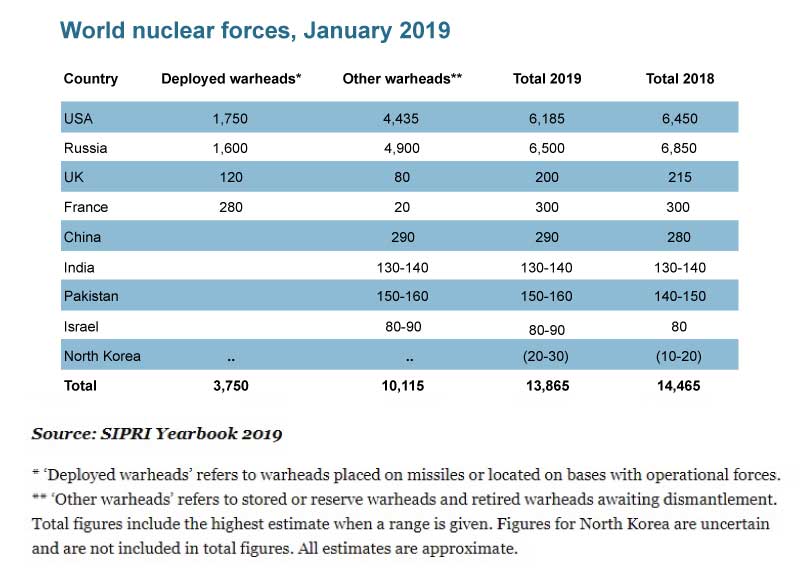
At the start of 2019, the US, Russia, Britain, France, China, India, Pakistan, Israel and North Korea had a total of some 13,865 nuclear weapons, according to estimates in a new report by the Stockholm International Peace Research Institute (SIPRI).
That represents a decrease of 600 nuclear weapons compared to the start of 2018. Of these 13,865, 3,750 are deployed with operational forces and nearly 2,000 of these are kept in a state of high operational alert.
But at the same time, all nuclear weapon-possessing countries are modernising these arms and China, India and Pakistan are also increasing the size of their arsenals.
“India and Pakistan are expanding their military fissile material production capabilities on a scale that may lead to significant increases in the size of their nuclear weapon inventories over the next decade,” said Shannon Kile, director of the SIPRI Nuclear Arms Control Programme.
The report separately counts “deployed warheads” (warheads placed on missiles or located on bases with operational forces) and “other warheads” (stored or reserve warheads and retired warheads awaiting dismantlement). For India, it gives a figure of 130-140 “other warheads” in 2019, the same as in 2018.
The number of nuclear arms has been drastically reduced since a peak in the mid-1980s when there were some 70,000 nuclear warheads in the world. “The world is seeing fewer but newer weapons,” Kile said.
What is the purpose of SIPRI?
Stockholm International Peace Research Institute (SIPRI) is an independent international institute dedicated to research into conflict, armaments, arms control and disarmament. Established in 1966, SIPRI provides data, analysis and recommendations, based on open sources, to policymakers, researchers, media and the interested public.
SIPRI’s mission is to…
* Undertake research and activities on security, conflict and peace
* Provide policy analysis and recommendations
* Facilitate dialogue and build capacities
* Promote transparency and accountability
* Deliver authoritative information to global audiences
The drop in nuclear weapons in recent years can mainly be attributed to the US and Russia, whose combined arsenals still make up more than 90 per cent of the world’s nuclear weapons.
This is in part due to the countries fulfilling their obligations under the Treaty on Measures for the Further Reduction and Limitation of Strategic Offensive Arms (New START) - which puts a cap on the number of deployed warheads and was signed by the US and Russia in 2010 - as well as getting rid of obsolete warheads from the Cold War era. In 2018, Russia and the US announced that they had achieved the final New START force reduction limits by the specified deadline.
The START treaty will expire in 2021, which Kile said was worrying since there are currently “no serious discussions underway about extending it”.
“The prospects for a continuing negotiated reduction of Russian and US nuclear forces appears increasingly unlikely given the political and military differences between the two countries,” Kile said.
New Strategic Arms Reduction Treaty
The New Strategic Arms Reduction Treaty (New START) was signed by Russia and the US and entered into force on February 5, 2011. New START replaced the 1991 START I treaty, which expired in December 2009, and superseded the 2002 Strategic Offensive Reductions Treaty (SORT), which terminated when New START came into force.
New START continues the bipartisan process of verifiably reducing US and Russian strategic nuclear arsenals begun by former presidents Ronald Reagan and George H.W. Bush. New START is the first verifiable US-Russian nuclear arms control treaty to take effect since START I in 1994.
Both Russia and the US announced that they met New START limitations by February 5, 2018.
Main treaty limits
Nuclear warhead limit
Seven years after coming into force (February 5, 2018), New START limits went into effect that capped accountable deployed strategic nuclear warheads and bombs at 1,550, down approximately 30 per cent from the 2,200 limit set by SORT and down 74 per cent from the START-accountable limit of 6,000. Each heavy bomber is counted as one warhead.
Missile, bomber and launcher limits
Deployed Intercontinental Ballistic Missiles (ICBMs), Submarine-Launched Ballistic Missiles (SLBMs), and heavy bombers assigned to nuclear missions are limited to 700. Deployed and non-deployed ICBM launchers, SLBM launchers and bombers are limited to 800. This number includes test launchers and bombers and Trident submarines in overhaul, and is approximately a 50 per cent reduction from the 1,600 launcher limit set under START (SORT did not cover launchers).
The 800 ceiling is intended to limit the ability for “break out” of the treaty by preventing either side from retaining large numbers of non-deployed launchers and bombers.
New START does not limit the number of non-deployed ICBMs and SLBMs, but it does monitor them and provide for continuous information on their locations and on-site inspections to confirm that they are not added to the deployed force. Non-deployed missiles must be located at specified facilities away from deployment sites and labelled with “unique identifiers” to reduce concerns about hidden missile stocks.
Force structure
Each side has the flexibility to structure its nuclear forces as it wishes, within the overall limits of the treaty.
Global disarmament efforts suffered a blow when the US announced in February it would withdraw from the Intermediate-Range Nuclear Forces (INF) treaty, prompting Russia to say it would also suspend its participation.
Next year, the treaty on the Non-Proliferation of Nuclear Weapons (NPT) - considered the cornerstone of the world’s nuclear order - turns 50.
While Kile said progress should not be underestimated, he also noted a number of worrying trends and the danger of a conventional conflict escalating to a nuclear one. There is also a more general trend towards an “increased salience” of nuclear weapons, where changing strategic doctrines, particularly in the US, are giving nuclear weapons an expanded role in both military operations and national security dialogue, Kile said.
“I think the trend is moving away from where we were five years ago, where the world’s nuclear weapons were being marginalised,” Kile said.