
- World
- Apr 22
High amounts of CO found in 2I/Borisov
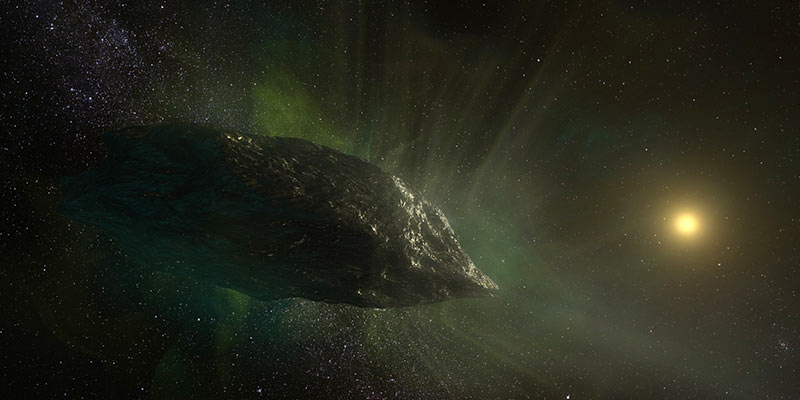
Scientists have discovered that a comet called 2I/Borisov — only the second interstellar object ever detected passing through the solar system — is surprisingly different in its composition from comets hailing from our celestial neighborhood.
Gas coming off 2I/Borisov contained high amounts of carbon monoxide — far more than comets formed in our solar system — indicating the object had large concentrations of carbon monoxide ice, researchers said.
The new results on the comet’s composition are published in the journal Nature Astronomy.
Carbon monoxide, poisonous to humans, is common as a gas in space and forms as ice only in the most frigid locations. The presence of so much carbon monoxide, the researchers said, suggests 2I/Borisov formed in a different manner than comets in our solar system — in a very cold outer region of its home star system or around a star cooler than the Sun.
What is an interstellar comet?
Comets are snowballs of ice, dust and frozen gas. When totally frozen (or “inactive”), they are approximately the diameter of a small town, but when heated by the Sun their tails can extend for millions of miles. 2I/Borisov is about the length of nine football fields, or 0.98 kilometers, making it relatively small.
All comets form in the primordial disk of material that encircles a young star, preserving remnants of a planetary system’s ancient past. Comets from our own solar neighborhood reveal the history of materials, including water, that made Earth the planet we know today, as well as our other planetary neighbors.
An interstellar comet, on the other hand, is a chemical ambassador from an entirely different star system — containing a treasure trove of clues to worlds too far to reach with modern technology.
“We like to refer to 2I/Borisov as a snowman from a dark and cold place,” said planetary scientist Dennis Bodewits of Auburn University in Alabama, lead author of one of two 2I/Borisov studies published in the journal Nature Astronomy.
“Comets are left-over building blocks from the time of planet formation. For the first time, we have been able to measure the chemical composition of such a building block from another planetary system while it flew through our own solarsystem,” Bodewits added.
Discovery of 2I/Borisov
The comet, detected in August 2019 by amateur astronomer Gennady Borisov, has zoomed through interstellar space after being ejected from its original star system.
It was born long ago in a rotating disc of gas and dust surrounding a newly formed star in a place that must have been rich in carbon monoxide, Bodewits said. That star may have been what is called an M-dwarf, far smaller and cooler than the sun and the smallest type of star that is known, Bodewits said.
Scientists initially concluded last year that 2I/Borisov was similar to comets from our solar system, but data from the Hubble Space Telescope and an observatory in Chile revealed its differences. The researchers also found an abundance of hydrogen cyanide at levels similar to comets from our solar system.
“This shows that 2I/Borisov is not a completely alien object, and confirms some similarity with our ‘normal’ comets, so the processes that shaped it are comparable to the way our own comets formed,” said Martin Cordiner, an astrobiologist working at NASA’s Goddard Space Flight Center in Maryland and lead author of the other study.
First known interstellar object
The only other interstellar visitor discovered in our solar system was a cigar-shaped rocky object called ‘Oumuamua spotted in 2017.
It was discovered by the University of Hawaii’s Pan-STARRS1 telescope, funded by NASA’s Near-Earth Object Observations (NEOO) programme, which finds and tracks asteroids and comets in Earth’s neighbourhood.
The object was officially named 1I/2017 U1 by the International Astronomical Union (IAU), which is responsible for granting official names to bodies in the solar system and beyond. In addition to the technical name, the Pan-STARRS team dubbed it ‘Oumuamua (pronounced oh MOO-uh MOO-uh), which is Hawaiian for “a messenger from afar arriving first”.
Manorama Yearbook app is now available on Google Play Store and iOS App Store