
- World
- Dec 16
Explainer / US Electoral College
The Electoral College decisively confirmed Joe Biden as the next US president, ratifying his November victory in an authoritative state-by-state repudiation of President Donald Trump’s refusal to concede he had lost.
The presidential electors gave Biden a solid majority of 306 electoral votes to Trump’s 232.
Electors in several major battleground states where Trump has unsuccessfully sought to reverse the outcome — Arizona, Georgia, Michigan, Nevada, Pennsylvania and Wisconsin — voted for Biden, who is set to take office on January 20 alongside running mate Kamala Harris.
Several senior Republican US senators acknowledged Democrat’s Biden as the country’s president-elect and rejected the idea of overturning the 2020 presidential election in Congress.
What is the US Electoral College?
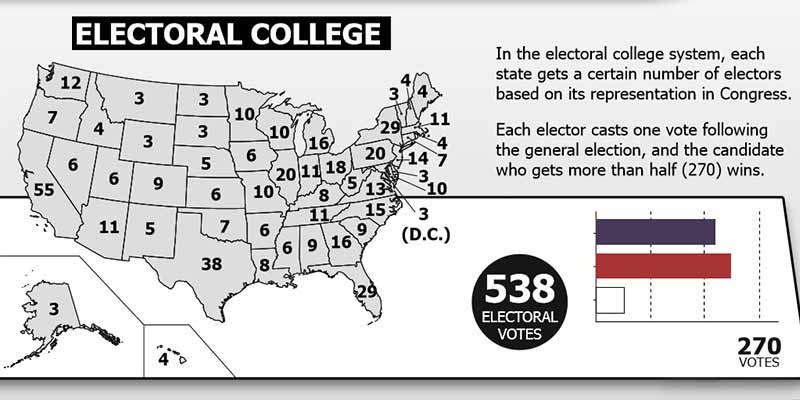
• The winner of the US presidential election is determined not by the popular vote but through a system called the Electoral College, which is mandated in the Constitution and allots ‘electoral votes’ to states and the District of Columbia based on their congressional representation.
• The Electoral College was the product of compromise during the drafting of the Constitution between those who favored electing the president by popular vote and those who opposed giving the people the power to directly choose their leader. Technically, Americans are casting votes for those slates of electors, not the candidates themselves.
• However, the term ‘Electoral College’ does not appear in the US Constitution. Article II of the Constitution and the 12th Amendment refer to ‘electors’, but not to the ‘Electoral College’.
• Electoral votes are allocated among the states based on the Census. Every state is allocated a number of votes equal to the number of senators and representatives in its US Congressional delegation — two votes for its senators in the US Senate plus a number of votes equal to the number of its Congressional districts.
• These electors are typically party loyalists who have pledged to support the candidate who got the most votes in their state.
• There are 538 electoral votes, meaning 270 are needed to win the election. Electors sign certificates showing their votes, which are sent to government officials, including the Vice President. Those certificates are paired with ones signed by governors showing the popular vote tallies.
What happens next?
• Electoral votes will be officially tallied by a newly seated Congress on January 6, in a special joint session.
• The congressional joint session to count electoral votes is generally a routine, ceremonious affair.
• The congressional count is the final step in reaffirming Biden’s presidential win, after the Electoral College officially elected him on December 14.
What happens generally during the Congress?
• Under federal law, Congress meets to open sealed certificates from each state that contain a record of their electoral votes. The votes are brought into the chamber in mahogany boxes.
• Bipartisan representatives of both chambers read the results out loud and do an official count. The president of the Senate — Vice President Mike Pence — presides over the session and declares the winner.
• If there is a tie, then the House decides the presidency, with each congressional delegation having one vote. That hasn’t happened since the 1800s.
Can Congress refuse to accept Biden’s Electoral votes?
• A US law called the Electoral Count Act allows individual members of the House and Senate to challenge the results during the January 6 special session — a rarely used procedure. Any objection to a state’s results must be backed by at least one House member and one senator. The two chambers would then separate to debate the objections before voting on whether to reject the state’s results. An objection must pass in both chambers by a simple majority.
Manorama Yearbook app is now available on Google Play Store and iOS App Store