
- World
- Nov 01
UNSC adopts resolution on protection of education in armed conflict
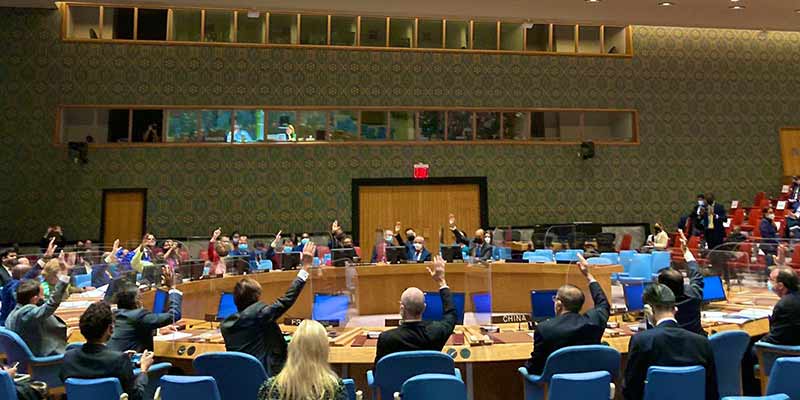
• The UN Security Council adopted a unique resolution strongly condemning attacks against schools, children and teachers and urging conflict parties to immediately safeguard the right to education.
• While the 15-member Council has issued previous statements decrying attacks on schools, this is its first resolution to explicitly focus on the link between education and peace and security.
• The draft resolution on the protection of education in conflict was put forward by Norway and Niger.
Escalating attacks
• The issue of education in conflict settings has gained prominence in the Security Council and the UN more broadly in recent years, as devastating attacks on schools and related civilians have escalated around the globe.
• According to UN data, attacks on schools and school infrastructure have grown alarmingly around the world, with more than 11,000 attacks between 2014 and 2019 affecting nearly 22,000 students and teachers in 93 countries.
• More than 75 million children around the world have seen their education disrupted by conflict.
Highlights of the resolution
• Through the resolution, delegates emphasized the invaluable role education plays for individuals and society, including as life-saving safe spaces.
• They noted that providing, protecting and facilitating the continuation of education in armed conflict, should remain a key priority for the international community.
• The Council urged countries to develop domestic legal frameworks to ensure respect for their relevant international legal obligations, including comprehensive measures to prevent attacks against schools, children, teachers and other related civilians.
• The Council condemned the military use of schools in contravention of international law, urging all parties to armed conflict to respect the civilian character of educational facilities, in accordance with international humanitarian law.
• Council members, speaking after the vote, roundly welcomed the resolution’s adoption, which is the first uniquely dedicated to the protection of classrooms and schools.
• The representative of Norway, along with the representative of Niger, said the text will help the Council make its voice heard against the growing disruption of education in conflict.
• India’s representative emphasized that the resolution’s reference to “facilitation of the continuation of education” by Member States applies only to situations of armed conflict. Such facilitation in situations of non-armed conflict should be discussed in other United Nations forums, he said, adding that India voted in favour with that understanding.
UN Security Council
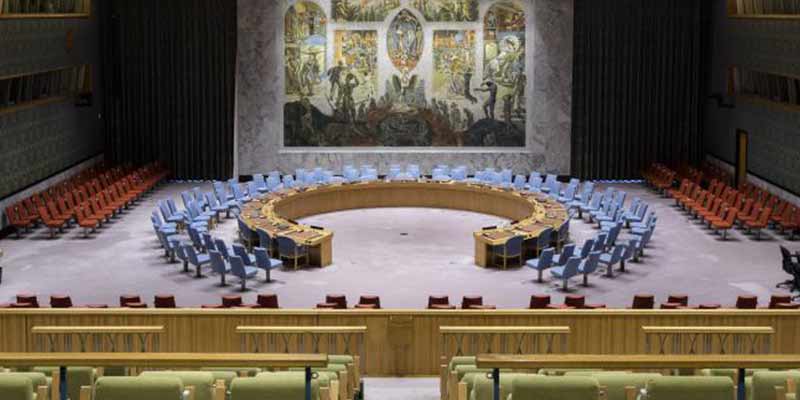
• The United Nations Charter established six main organs of the United Nations, including the Security Council. It gives primary responsibility for maintaining international peace and security to the Security Council.
• All members of the United Nations agree to accept and carry out the decisions of the Security Council. While other organs of the United Nations make recommendations to Member States, only the Security Council has the power to make decisions that member states are then obligated to implement under the Charter.
• The Security Council held its first session on January 17, 1946 at Church House, Westminster, London. Since its first meeting, the Security Council has taken permanent residence at the United Nations Headquarters in New York City.
• A representative of each of its members must be present at all times at UN Headquarters so that the Security Council can meet at any time as the need arises.
• The Security Council takes the lead in determining the existence of a threat to the peace or act of aggression.
• It calls upon the parties to a dispute to settle it by peaceful means and recommends methods of adjustment or terms of settlement.
• In some cases, the Security Council can resort to imposing sanctions or even authorise the use of force to maintain or restore international peace and security.
• The Council is composed of 15 members.
• Five permanent members are: China, France, Russian Federation, the United Kingdom, and the United States.
• Ten non-permanent members are elected for two-year terms by the General Assembly.
The 10 non-permanent seats are distributed on a regional basis as follows:
• Five for African and Asian States.
• One for Eastern European States.
• Two for the Latin American and Caribbean States.
• Two for Western European and other States.
• Each year the General Assembly elects five non-permanent members for a two-year term.
• To be elected to the Council, candidate countries need a two-third majority of ballots of Member States that are present and voting in the Assembly.
The ten non-permanent members elected for two-year terms (with end of term year) :
• Estonia (2021)
• India (2022)
• Ireland (2022)
• Kenya (2022)
• Mexico (2022)
• Niger (2021)
• Norway (2022)
• Saint Vincent and the Grenadines (2021)
• Tunisia (2021)
• Vietnam (2021).
Manorama Yearbook app is now available on Google Play Store and iOS App Store