
- World
- Oct 10
3 US-based economists win Nobel for Economics

• Former chair of the US Federal Reserve Ben S. Bernanke, along with two US-based economists Douglas Diamond and Philip Dybvig won the 2022 Nobel Economics Prize “for research on banks and financial crises”.
• The Prize, formally known as the Sveriges Riksbank Prize in Economic Sciences in Memory of Alfred Nobel, is the last of this year’s crop of Nobel Prizes.
• Unlike the other Nobel Prizes, the economics award wasn’t established in the will of Alfred Nobel but by the Swedish central bank in his memory in 1968, with the first winner selected a year later.
• This year’s laureates in the Economic Sciences — Ben Bernanke, Douglas Diamond and Philip Dybvig — have significantly improved our understanding of the role of banks in the economy, particularly during financial crises. An important finding in their research is why avoiding bank collapses is vital.
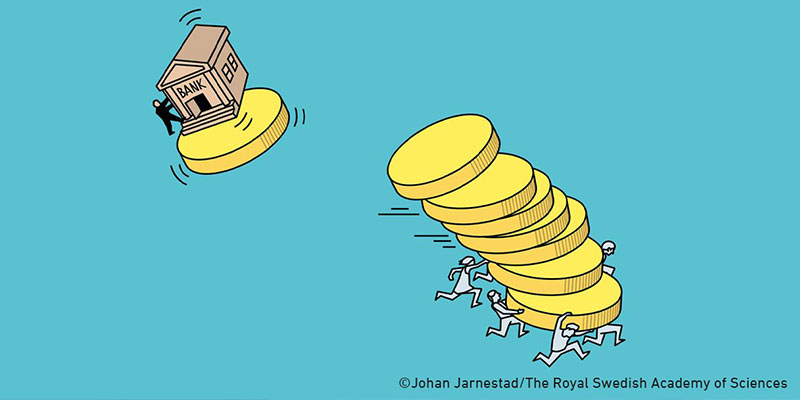
The central role of banks in financial crises
• We all have some sort of relationship to banks. Our regular income is placed in a bank account and we use the bank’s means of payment, such as mobile banking apps or bank cards, when we shop at a supermarket or pay a restaurant bill. At some time in our lives, many of us will need to take a large bank loan, for example to buy a house or apartment. The same applies to businesses – they need to be able to make and receive payments and to finance their investments. In most cases, these services are also provided via a bank.
• We take for granted that these services function as they should, perhaps with the exception of brief technical problems. Sometimes, however, all or parts of the banking system fail and a financial crisis arises. Important banks collapse, borrowing becomes more expensive or impossible, prices plunge for property and other assets.
• If this progression is not stopped, the entire economy can enter a downward spiral of rapidly increasing unemployment and bankruptcies. Some of the biggest economic collapses in history have been financial crises.
• For the economy to function, savings must be channelled to investments. However, there is a conflict here: savers want instant access to their money in case of unexpected outlays, while businesses and homeowners need to know they will not be forced to repay their loans prematurely.
Diamond and Dybvig’s model
• In an article from 1983, Diamond and Dybvig showed how banks offer an optimal solution to this problem. By acting as intermediaries that accept deposits from many savers, banks can allow depositors to access their money when they wish, while also offering long-term loans to borrowers.
• However, their analysis also showed how the combination of these two activities makes banks vulnerable to rumours about their imminent collapse. If a large number of savers simultaneously run to the bank to withdraw their money, the rumour may become a self-fulfilling prophecy – a bank run occurs and the bank collapses. These dangerous dynamics can be prevented through the government providing deposit insurance and acting as a lender of last resort to banks.
• Diamond demonstrated how banks perform another societally important function. As intermediaries between many savers and borrowers, banks are better suited to assessing borrowers’ creditworthiness and ensuring that loans are used for good investments.
• These insights form the foundation of modern bank regulation.
Bank crises led to depression
• The Great Depression of the 1930s paralysed the world’s economies for many years and had vast societal consequences.
• The work for which Bernanke is now being recognised is formulated in an article from 1983, which analyses the Great Depression of the 1930s. Between January 1930 and March 1933, US industrial production fell by 46 per cent and unemployment rose to 25 per cent. The crisis spread like wildfire, resulting in a deep economic downturn in much of the world. In Great Britain, unemployment increased to 25 per cent and to 29 per cent in Australia. In Germany, industrial production almost halved and more than one third of the workforce was out of work. In Chile, national income fell by 33 per cent between 1929 and 1932.
• Everywhere, banks collapsed, people were forced to leave their homes and widespread starvation occurred even in relatively rich countries. The world’s economies slowly began to recover only towards the middle of the decade.
• Before Bernanke published his article, the conventional wisdom among experts was that the depression could have been prevented if the US central bank had printed more money. Bernanke also shared the opinion that a shortage of money probably contributed to the downturn, but believed this mechanism could not explain why the crisis was so deep and protracted.
• Instead, Bernanke showed that its main cause was the decline in the banking system’s ability to channel savings into productive investments. Using a combination of historical sources and statistical methods, his analysis showed which factors were important in the drop in gross domestic product (GDP). He found that factors that were directly linked to failing banks accounted for the lion’s share of the downturn.
• Among other things, he showed how bank runs were a decisive factor in the crisis becoming so deep and prolonged. When the banks collapsed, valuable information about borrowers was lost and could not be recreated quickly. Society’s ability to channel savings to productive investments was thus severely diminished.
Manorama Yearbook app is now available on Google Play Store and iOS App Store