
- World
- Jan 10
Gabriel Attal becomes France’s youngest PM
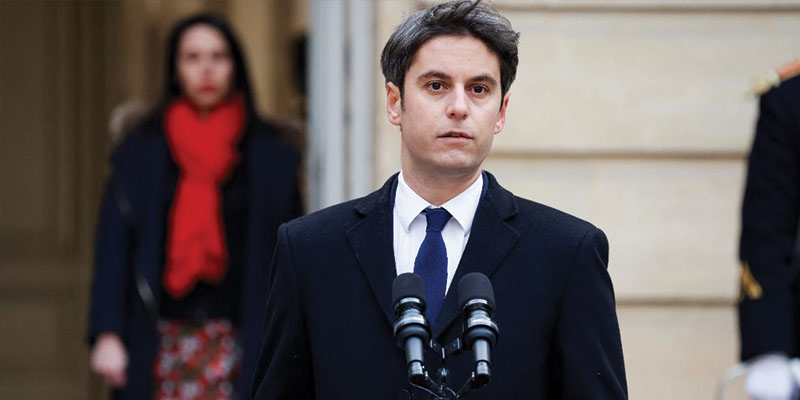
• French President Emmanuel Macron appointed Gabriel Attal as Prime Minister.
• Attal will be France’s youngest PM and the first to be openly gay.
• Attal replaces Elisabeth Borne, 62, only the second woman to hold the Prime Minister’s role in France.
• Borne stepped down after serving less than two years in office. This period was marked by months of protests over the pension overhaul and riots over the police shooting of a teenager of north African descent.
• Macron, 46, who was France’s youngest-ever President when he came to power in 2017, is set to work with Attal to name a new government in the coming days.
• The overhaul comes ahead of the Olympic Games in Paris and European Parliament elections this summer.
• The appointment of Attal signals a desire by Macron to move beyond divisive reforms and improve his centrist party’s chances in the upcoming elections.
• A wider cabinet reshuffle is expected this week as Macron seeks to sharpen his team for the final three years of his presidency.
Attal is one of France’s most popular politicians
• Attal joined the Socialist Party when he was 17. He became a household name in French politics after being named government spokesman during the pandemic. He would later be named as a junior minister in the finance ministry and then education minister in 2023.
• Attal was polled as one of France’s most popular politicians in recent months.
• He became a household name as government spokesman during the COVID-19 pandemic and earned a reputation as a smooth communicator.
• Attal is France’s youngest post-war PM, a record previously held by the leftist Laurent Fabius, who was 37 when he was named PM by Francois Mitterrand in 1984.
French Parliament system
• The Constitution of the Fifth Republic, adopted in 1958, was amended by referendum in 1962 to establish the direct election of the President by universal suffrage.
• This created a hybrid political regime with some presidential and some parliamentary characteristics, sometimes described as a ‘semi-presidential regime’ or a ‘hyper-presidential’ regime.
• The government is responsible to Parliament, but contrary to classical parliamentary regimes, the President plays an important role.
• The Parliament is bicameral and is made up of the National Assembly and the Senate.
The Parliament has two houses:
i) The 348 French Senators are elected through indirect universal suffrage for six years.
ii) The National Assembly, with 577 deputies elected by direct universal suffrage for five years.
• The indirectly elected Senate represents the ‘territorial communities of the Republic’ and shares legislative power with the National Assembly. It embodies continuity, as it cannot be dissolved and half of its Members are renewed every three years. However, in cases of disagreement, the National Assembly has the final say.
• The President appoints the Prime Minister, who proposes the members of government to the President, who then appoints them.
• The President chairs the Council of Ministers, enacts laws and is the head of the armed forces. The President can dissolve the National Assembly, and, in the event of serious crisis, exercise emergency powers
• Traditionally, the Prime Minister makes the government’s programme or a general policy statement an issue of a vote of confidence before the National Assembly.
• Legislative powers are exercised by the two houses, who vote on laws, monitor government action and assess public policy.
Manorama Yearbook app is now available on Google Play Store and iOS App Store