
- World
- Jun 27
Explainer - SVOM mission by France & China
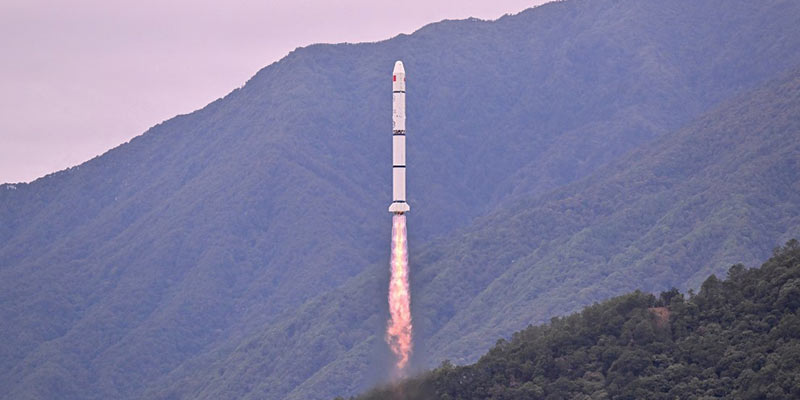
• A French-Chinese satellite blasted off on June 22 on a hunt for the mightiest explosions in the universe, in a notable example of cooperation between a Western power and the Asian giant.
• Developed by engineers from both countries, the Space Variable Objects Monitor (SVOM) will seek out gamma-ray bursts, the light from which has travelled billions of light years to reach Earth.
• The 930-kilogram satellite carrying four instruments — two French, two Chinese — took off aboard a Chinese Long March 2-C rocket from a space base in Xichang, in the southwestern province of Sichuan.
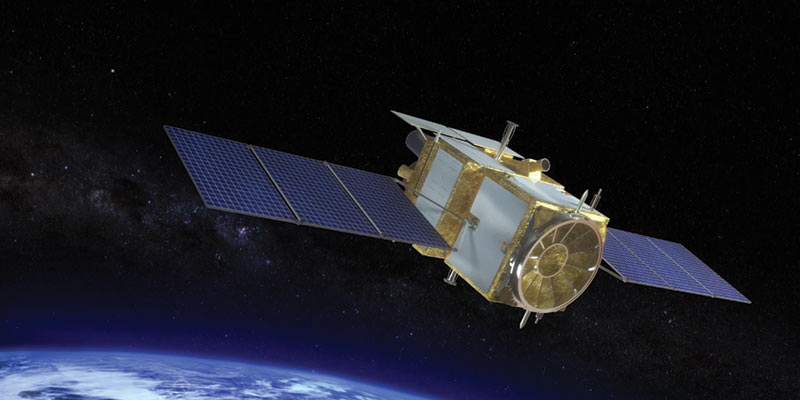
SVOM mission
The SVOM mission (Space-based multi-band astronomical Variable Objects Monitor) is a Franco-Chinese mission dedicated to the study of the most distant explosions of stars, the gamma-ray bursts.
It is the result of a collaboration between the two national space agencies, CNSA (China National Space Administration) and CNES (Centre national d’études spatiales), with the main contributions of the Institute of Research into the Fundamental Laws of the Universe (Irfu) and the Research Institute of Astrophysics and Planetology (IRAP) for France and the National Astronomical Observatory (NAO) and the Beijing High Energy Institute (IHEP) for China.
The mission consists of four main instruments of which two are French (ECLAIRs and MXT) and two are Chinese (GRM and VT):
i) The ECLAIRs telescope to detect and localise gamma bursts in the X-ray band and low-energy gamma rays (from 4 to 250 keV).
ii) The MXT telescope (Microchannel X-ray Telescope) for the observation of gamma burst in the soft X-ray range (0.2 to 10keV).
iii) The GRM (Gamma Ray Burst Monitor) to measure the spectrum of high-energy bursts (from 15 keV to 5000 keV).
iv) The VT telescope (Visible Telescope) operating in the visible range to detect and observe the visible emission produced immediately after a gamma burst.
What is gamma-ray burst (GRB)?
• GRBs are the most powerful events in the universe, detectable across billions of light-years.
• Astronomers classify them as long or short based on whether the event lasts for more or less than two seconds.
• Gamma-ray bursts generally occur after the explosion of huge stars — those more than 20 times as big as the Sun — or the fusion of compact stars.
• The extremely bright cosmic beams can give off a blast of energy equivalent to over a billion billion suns.
• The rays carry traces of the gas clouds and galaxies they pass through on their journey through space — valuable data for better understanding the history and evolution of the universe.
• The main challenge is that gamma-ray bursts are extremely brief, leaving scientists in a race against time to gather information.
• Once it detects a burst, SVOM will send an alert to a team on duty around the clock.
• Within five minutes, they will have to rev up a network of telescopes on the ground that will align precisely with the axis of the burst’s source to make more detailed observations.
• Once analysed, the data could help to better understand the composition of space, the dynamics of gas clouds or other galaxies.
• The project stems from a partnership between the French and Chinese space agencies as well as other scientific and technical groups from both nations.
Manorama Yearbook app is now available on Google Play Store and iOS App Store