
- World
- Aug 29
NASA’s Perseverance rover on Mars begins long climb up Jezero Crater
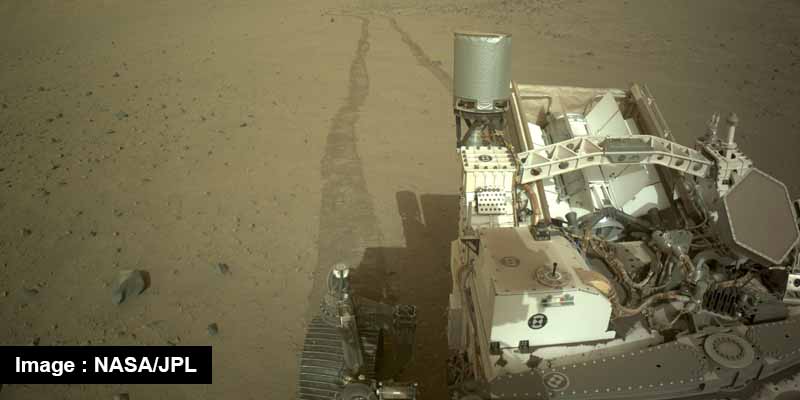
• NASA’s Perseverance rover is tackling a steep new challenge on Mars.
• The rover began months-long ascent up the western rim of Jezero Crater that is likely to include some of the steepest and most challenging terrain the rover has encountered to date.
• The six-wheeled rover has spent the last three-and-a-half years roaming around the bottom of a crater.
• The rover will go up 1,000 feet (305 meters) to the rim of Jezero Crater to dig up rock samples.
• The rover is a car-sized, six-wheeled vehicle carrying scientific instruments.
• Since landing on the red planet in 2021, Perseverance has collected 22 rock core samples from the floor of the crater, which was once filled with water.
• The rover’s samples may help scientists piece together what the planet’s climate looked like billions of years ago and learn whether any ancient Martian life lurked. NASA is exploring ways to bring the rock samples to Earth.
Jezero Crater
• Jezero Crater is located on the western edge of Isidis Planitia, a giant impact basin just north of the Martian equator.
• Western Isidis presents some of the oldest and most scientifically interesting landscapes Mars has to offer. Scientists believe the 45-kilometer-wide crater was home to a lake about 3.5 billion years ago.
• The word “Jezero” in several slavic languages means “lake” – as well as an ancient river delta.
• Reaching the top of the crater won’t be easy. To get there, Perseverance will rely on its auto-navigation capabilities as it follows a route that rover planners designed to minimise hazards while still giving the science team plenty to investigate.
• Encountering slopes of up to 23 degrees on the journey (rover drivers avoid terrain that would tilt Perseverance more than 30 degrees), the rover will have gained about 1,000 feet in elevation by the time it summits the crater’s rim.
• Two of the priority regions the science team wants to study at the top of the crater are nicknamed ‘Pico Turquino’ and ‘Witch Hazel Hill’.
• Imagery from NASA’s Mars orbiters indicates that Pico Turquino contains ancient fractures that may have been caused by hydrothermal activity in the distant past.
• Orbital views of Witch Hazel show layered materials that likely date from a time when Mars had a very different climate than today. Those views have revealed light-toned bedrock similar to what was found at “Bright Angel,” the area where Perseverance recently discovered and sampled the “Cheyava Falls” rock, which exhibits chemical signatures and structures that could possibly have been formed by life billions of years ago when the area contained running water.

Mars 2020 Perseverance mission
• The Mars 2020 mission spacecraft, carrying the Perseverance rover, launched from Cape Canaveral, Florida, on July 30, 2020.
• After a nearly seven month journey through space, Perseverance rover successfully touched down on the surface of Mars on February 19, 2021.
• A key objective of Perseverance’s mission on Mars is astrobiology, including caching samples that may contain signs of ancient microbial life.
• The rover will characterise the planet’s geology and past climate, to help pave the way for human exploration of the Red Planet and as the first mission to collect and cache Martian rock and regolith.
• The Mars 2020 Perseverance mission is part of NASA’s Moon to Mars exploration approach, which includes Artemis missions to the Moon that will help prepare for human exploration of the Red Planet.
Manorama Yearbook app is now available on Google Play Store and iOS App Store