
- World
- Nov 21
US vetoes Gaza ceasefire resolution at UN Security Council
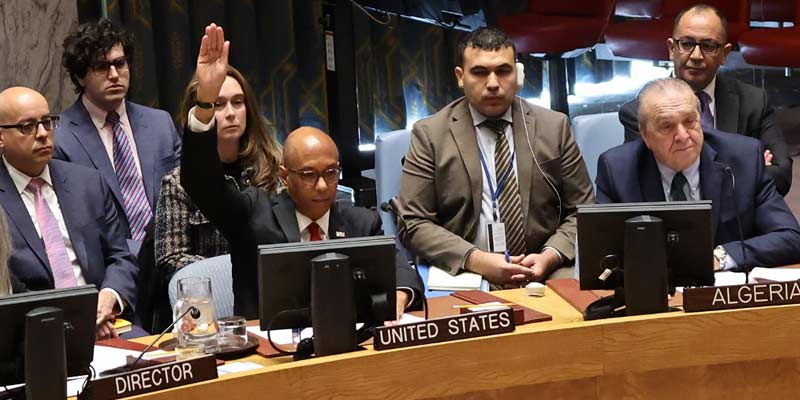
• The United States vetoed a UN Security Council resolution demanding an immediate ceasefire in the war in Gaza because it was not linked to an immediate release of hostages taken captive by Hamas militants in Israel in October 2023.
• Despite having secured 14 votes in favour, the draft resolution put forward by the 10 elected members of the Security Council failed to pass owing to the negative vote by a permanent member — the US.
• For a resolution to be adopted, it must secure at least nine votes in favour, and no negative votes (or vetoes) by any of the five permanent members.
• The US representative Ambassador Robert Wood said in his statement that the US could not support an unconditional ceasefire unless it was tied to releasing the hostages being held in Gaza by Hamas and other militants.
• Had the draft resolution been adopted, it would have demanded immediate access for civilians in the Gaza Strip to basic services.
• The Security Council has adopted several resolutions on Gaza, including for a ceasefire during the Muslim holy month of Ramadan and demanding humanitarian access. The United States as well as Russia and China have vetoed several previous resolutions on the war.
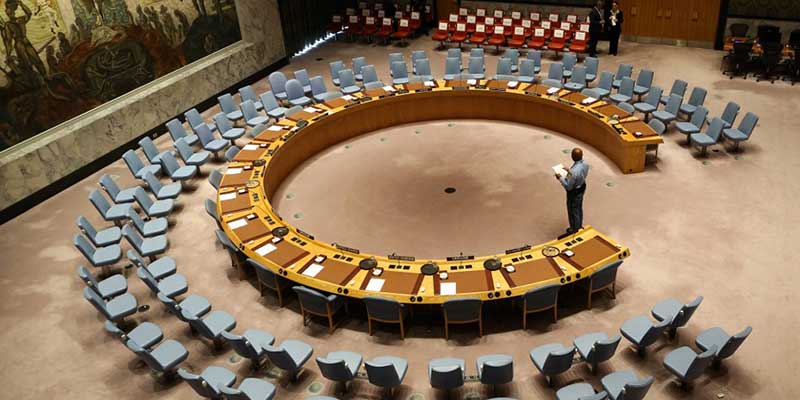
UN Security Council
• The United Nations Charter established six main organs of the United Nations, including the Security Council. It gives primary responsibility for maintaining international peace and security to the Security Council.
• All members of the United Nations agree to accept and carry out the decisions of the Security Council. While other organs of the United Nations make recommendations to Member States, only the Security Council has the power to make decisions that member states are then obligated to implement under the Charter.
• The Security Council held its first session on January 17, 1946 at Church House, Westminster, London. Since its first meeting, the Security Council has taken permanent residence at the United Nations Headquarters in New York City.
• A representative of each of its members must be present at all times at UN headquarters so that the Security Council can meet at any time as the need arises.
• The Security Council takes the lead in determining the existence of a threat to the peace or act of aggression.
• It calls upon the parties to a dispute to settle it by peaceful means and recommends methods of adjustment or terms of settlement.
• In some cases, the Security Council can resort to imposing sanctions or even authorise the use of force to maintain or restore international peace and security.
• The Council is composed of 15 members.
• Five permanent members are: China, France, Russian Federation, the United Kingdom, and the United States.
• Ten non-permanent members are elected for two-year terms by the General Assembly.
The right to veto
• The creators of the United Nations Charter conceived that five countries — China, France, the USSR (which was succeeded in 1990 by the Russian Federation), the United Kingdom and the United States — because of their key roles in the establishment of the United Nations, would continue to play important roles in the maintenance of international peace and security.
• They were granted the special status of Permanent Member States at the Security Council, along with a special voting power known as the “right to veto”.
• It was agreed by the drafters that if any one of the five permanent members cast a negative vote in the 15-member Security Council, the resolution or decision would not be approved.
• All five permanent members have exercised the right of veto at one time or another.
• If a permanent member does not fully agree with a proposed resolution but does not wish to cast a veto, it may choose to abstain, thus allowing the resolution to be adopted if it obtains the required number of nine favourable votes.
India’s stand on veto power
India has emphasised that the exercise of veto in the UNSC is driven by political considerations and not by moral obligations, saying that only five permanent members being given the privilege of using the veto goes against the very concept of sovereign equality of states.
Manorama Yearbook app is now available on Google Play Store and iOS App Store