
- World
- Jul 11
Dust storms affect over 33 crore people in 150 countries
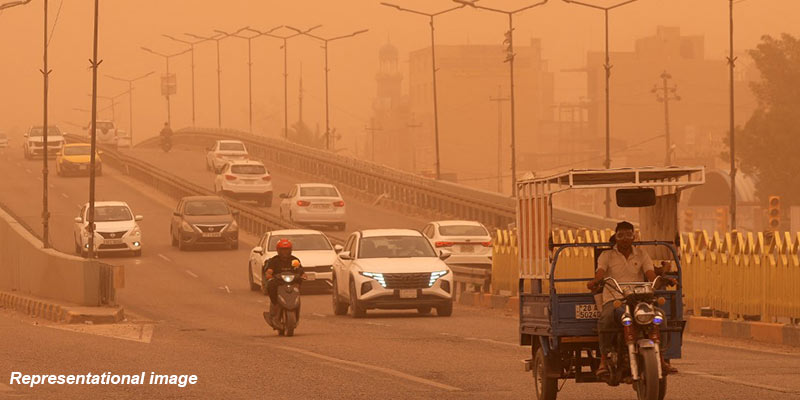
• The annual WMO Airborne Dust Bulletin highlights hotspots and impacts of a hazard which affects about 330 million people in more than 150 countries worldwide.
• The UN weather agency’s reports warns that while the amount of dust decreased marginally in 2024, the impact on humans and economies is increasing.
• In the most affected areas, the surface dust concentration in 2024 was higher than the long-term 1981-2010 average.
• Every year, around 2,000 million tonnes of sand and dust enters the atmosphere — equivalent to 307 Great Pyramids of Giza.
• While the movement of sand and dust is a natural weather process, increased land degradation and water mismanagement have, in the past few decades, exacerbated the prevalence and geographic spread.
• Dust and sand particles — 80 per cent of which come from North Africa and the Middle East — can be transported thousands of kilometres across borders and oceans.
• Dust and sand from the Western Sahara travelled all the way to Spain’s Canary Islands. Fierce winds and drought in Mongolia brought dust to Beijing and northern China.
• The estimated peak annual mean surface dust concentration was located in the central African nation of Chad, at about 800–1,100 µg m3 (micrograms per cubic meter air). This is because it is home to the Bodele Depression, which is one of the key emission sources.
• In the southern hemisphere, it was highest in parts of central Australia and the west coast of South Africa.
• In 2024, sand and dust concentrations were lower than the long-term average in many of the main source areas, and higher than average in many areas to where the dust is blown.
• The regions that are most vulnerable to long-range transport of dust are: the northern tropical Atlantic Ocean between West Africa and the Caribbean; South America; the Mediterranean Sea; the Arabian Sea; the Bay of Bengal; central-eastern China.
• In 2024, the transatlantic transport of African dust invaded parts of the Caribbean Sea region.
• The storms can obscure sunlight, altering ecosystems on land and in the ocean. In addition to environmental impacts, these weather occurrences have profound impacts on humans and their economies.
Health impacts
• A new sand and dust storm indicator developed by WMO and the World Health Organisation shows that 3.8 billion people (nearly half the world’s population) were exposed to dust levels exceeding WHO’s safety threshold between 2018-2022.
• This represents a 31 per cent increase from 2.9 billion people (44.5 per cent) during 2003-2007.
• Exposure varied widely, from only a few days in relatively unaffected areas to more than 87 per cent of days — equivalent to over 1,600 days in five years—in the most dust-prone regions.
Economic costs
• The economic impact is often under-estimated, according to a case study from the United States. In the US alone, dust and wind erosion cost an estimated $154 billion in 2017 — more than a fourfold increase over the 1995 calculation.
• The estimate included costs to households, crops, wind and solar energy, mortality from fine dust exposure, health costs due to Valley fever, and transport.
• The true cost of dust was certainly much higher, since reliable national-scale evaluations of many of dust’s other economic impacts (for example, on human morbidity, the hydrological cycle, aviation and rangeland agriculture) were not available, according to the study which was published in Nature.
• While the costs of dust related to cropland agriculture appear to have declined, the economic burden on the other analysed sectors has increased, most of them greatly.
Manorama Yearbook app is now available on Google Play Store and iOS App Store