
- World
- Jul 30
- Sreesha V.M
Global hunger declines, food insecurity rises in Africa
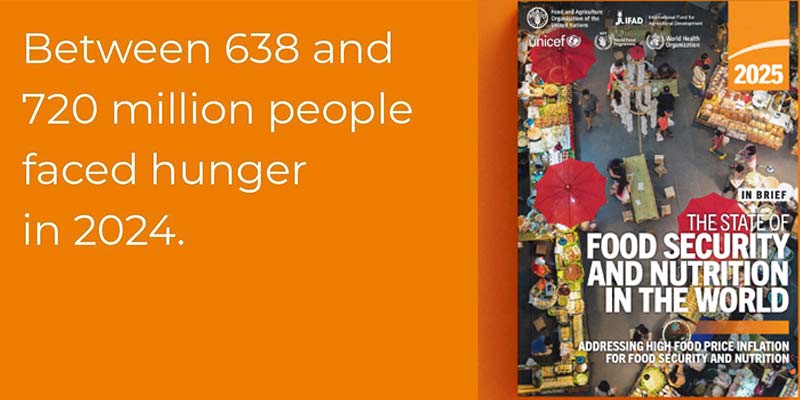
• An estimated 8.2 per cent of the global population, or about 673 million people, experienced hunger in 2024, down from 8.5 per cent in 2023 and 8.7 per cent in 2022, according to this year’s ‘The State of Food Security and Nutrition in the World’ (SOFI 2025) report published by five specialised agencies of the United Nations.
• Launched during the Second UN Food Systems Summit Stocktake (UNFSS+4) in Addis Ababa, SOFI 2025 indicates that between 638 and 720 million people faced hunger in 2024.
• However, progress was not consistent across the globe, as hunger continued to rise in most sub-regions of Africa and western Asia.
• The report was published by five UN agencies: Food and Agriculture Organisation (FAO), International Fund for Agricultural Development (IFAD), UN Children's Fund (UNICEF), World Food Programme (WFP), and World Health Organization (WHO).
• They noted that hunger and food security estimates remain above pre-pandemic levels due to a “perfect storm” of COVID-19 inflation, the war in Ukraine and climate shocks.
Key points of the report:
• While some progress and recovery have been made in recent years, the world is still above pre-COVID-19 pandemic levels and far from eradicating hunger and food insecurity by 2030.
• It is estimated that between 638 and 720 million people, corresponding to 7.8 and 8.8 per cent of the global population, respectively, faced hunger in 2024.
• About 2.3 billion people in the world are estimated to have been moderately or severely food insecure in 2024.
• The proportion of the population facing hunger in Africa surpassed 20 per cent in 2024, affecting 307 million people, while in western Asia an estimated 12.7 per cent of the population, or more than 39 million people, may have faced hunger in 2024.
• Food insecurity is on the rise in Africa and falling in Latin America and the Caribbean.
• Notable improvements are seen in southern Asia and Latin America. The prevalence of undernourishment (PoU) in Asia fell from 7.9 percent in 2022 to 6.7 per cent, or 323 million people, in 2024. Additionally, Latin America and the Caribbean as a region saw the PoU fall to 5.1 per cent, or 34 million people, in 2024, down from a peak of 6.1 per cent in 2020.
• Unfortunately, this positive trend contrasts sharply with the steady rise in hunger across Africa and western Asia, including in many countries affected by prolonged food crises.
• The proportion of the population facing hunger in Africa surpassed 20 per cent in 2024, affecting 307 million people, while in western Asia an estimated 12.7 per cent of the population, or more than 39 million people, may have faced hunger in 2024.
• It is projected that 512 million people could be chronically undernourished by 2030. Almost 60 per cent of those will be in Africa. This highlights the immense challenge of achieving SDG 2 (Zero Hunger).
• From 2023 to 2024, the global prevalence of moderate or severe food insecurity – an assessment registering the experience of constraints on access to adequate food during part of the year – decreased slightly, from 28.4 to 28.0 per cent, accounting for 2.3 billion people. This is 335 million more than in 2019, before the COVID-19 pandemic, and 683 million more than in 2015, when the Sustainable Development Agenda was adopted.
• Among the indicators of child nutrition, the prevalence of stunting in children under five declined from 26.4 per cent in 2012 to 23.2 per cent in 2024, reflecting global progress.
• The prevalence of child overweight (5.3 per cent in 2012 and 5.5 per cent in 2024), and in child wasting (7.4 per cent in 2012 and 6.6 per cent in 2024) remains largely unchanged.
• The percentage of infants under six months exclusively breastfed increased significantly, from 37.0 per cent in 2012 to 47.8 per cent in 2023, reflecting growing recognition of its health benefits.
• The prevalence of adult obesity rose from 12.1 per cent in 2012 to 15.8 per cent in 2022.
• New data show an increase in the global prevalence of anaemia among women aged 15 to 49, from 27.6 per cent in 2012 to 30.7 per cent in 2023.
• Estimates for a new SDG indicator introduced in the report reveal that about one-third of children aged 6 to 23 months and two-thirds of women aged 15 to 49 years met minimum dietary diversity.
• The report recommends a combination of policy responses to fight global food price inflation. These include targeted fiscal measures to protect the most affected, credible and transparent monetary policies to keep inflation in check and strategic investments in agrifood systems.
(The author is a trainer for Civil Services aspirants.)