
- World
- Nov 08
US Air Force tests Minuteman III missile
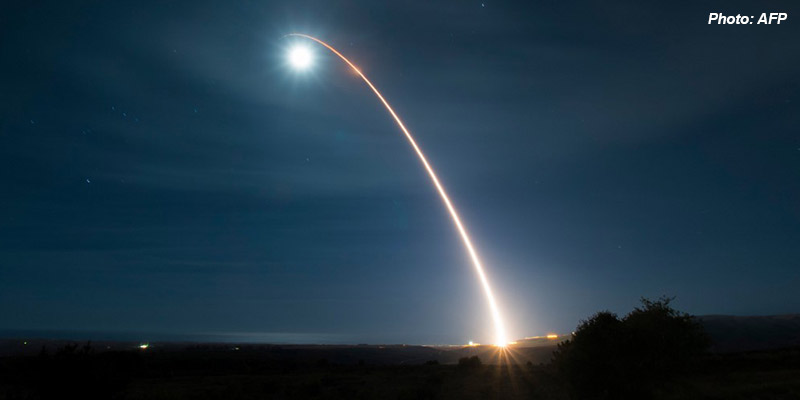
• The US Air Force Global Strike Command conducted a test launch of an unarmed Minuteman III intercontinental ballistic missile (ICBM) from Vandenberg Space Force Base, California, on November 5.
• The unarmed ICBM’s re-entry vehicle travelled approximately 6,700 km to the US Army Space and Missile Defence Command’s Ronald Reagan Ballistic Missile Defence Test Site at the Kwajalein Atoll in the Republic of the Marshall Islands.
• The Reagan Test Site, equipped with advanced sensors, including high-fidelity metric and signature radars, optical sensors, and telemetry, collected critical data during the terminal phase of flight.
• This test evaluated the ongoing reliability, operational readiness, and accuracy of the ICBM system, a cornerstone of America’s national defence.
Key points on Minuteman weapon system:
• The Minuteman is a strategic weapon system using a ballistic missile of intercontinental range.
• The Minuteman weapon system was conceived in the late 1950s and Minuteman I was deployed in the early 1960s.
• Both the missile and basing components incorporated significant advances beyond the relatively slow-reacting, liquid-fueled, remotely-controlled ICBMs of the previous generation.
• From the beginning, Minuteman missiles have provided a quick-reacting, inertially guided, highly survivable component to America’s strategic deterrent program.
• Minuteman’s maintenance concept capitalises on high reliability and a “remove and replace” approach to achieve a near 100 per cent alert rate.
• Modernisation programs have resulted in new versions of the missile, expanded targeting options, improved accuracy and survivability.
• Today’s Minuteman weapon system is the product of almost 60 years of continuous enhancement.
• The current ICBM force consists of 400 Minuteman III missiles.
• The ICBM has a range of about 10,000 km.