
- World
- Nov 11
Canada loses measles elimination status
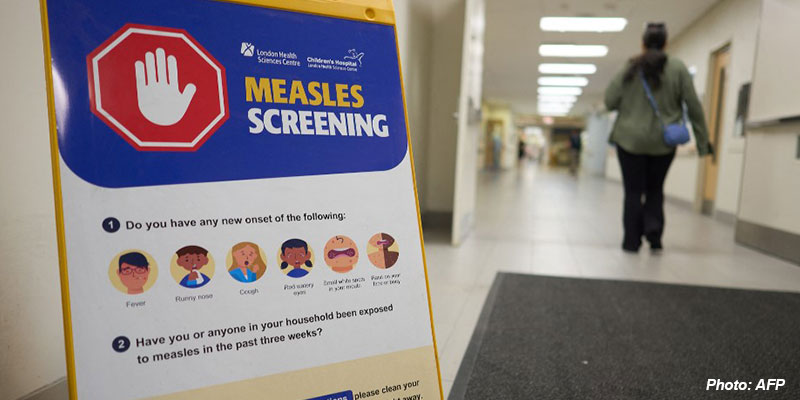
• The Pan American Health Organisation (PAHO) announced that the Region of the Americas has lost its verification as free from endemic measles transmission.
• The decision follows the conclusion of the PAHO Measles, Rubella, and Congenital Rubella Syndrome Elimination Regional Monitoring and Re-Verification Commission, which met in Mexico City from November 4 to 7 to review the epidemiological situation across the region.
• The Commission determined that endemic measles transmission has been re-established in Canada, where the virus has circulated for at least 12 months.
• As a result, the Americas, which was the first region in the world to eliminate measles twice, has now lost its measles-free status.
• All other countries continue to maintain their measles elimination status.
• The Americas have previously faced setbacks, including temporary loss of measles elimination status in Venezuela (2018) and Brazil (2019). The region regained elimination status in 2024 through coordinated regional action.
• To regain measles elimination status, a country must demonstrate interruption of endemic transmission for at least 12 consecutive months, supported by comprehensive vaccination, surveillance, and outbreak-response data.
One of the most contagious diseases
• Measles is one of the world’s most contagious diseases.
• Measles is caused by a virus in the paramyxovirus family. The virus infects the respiratory tract, then spreads throughout the body. Measles is a human disease and is not known to occur in animals.
• It is spread by coughing and sneezing, close personal contact or direct contact with infected nasal or throat secretions.
• Measles can damage the immune system by “erasing” its memory of how to fight infections, leaving survivors vulnerable to other diseases.
• Symptoms of measles usually begin 10-14 days after exposure to the virus. A prominent rash is the most visible symptom. The rash begins about 7-18 days after exposure, usually on the face and upper neck. It spreads over about three days, eventually to the hands and feet. It usually lasts five-six days before fading.
• Even when people survive measles, serious health effects can occur, some of which are lifelong. Infants and young children are at greatest risk of serious complications from the disease, which include blindness, pneumonia, and encephalitis (an infection causing brain swelling and potentially brain damage).
• Before the introduction of the measles vaccine in 1963 and widespread vaccination, major epidemics occurred approximately every 2-3 years and measles caused an estimated 2.6 million deaths each year.
• Measles outbreaks can result in epidemics that cause many deaths, especially among young, malnourished children. In countries where measles has been largely eliminated, cases imported from other countries remain an important source of infection.
• Most measles-related deaths are caused by complications including swelling of the brain and dehydration.
• Serious complications are most serious in children under five and adults over 30.
• There is no specific treatment for measles, but the two-dose vaccine against it is about 97 per cent effective in preventing severe illness and death.
• Measles vaccination averted more than 60 million deaths between 2000 and 2023.
Current situation in Americas
• As of November 7, as many as 12,596 confirmed measles cases have been reported across 10 countries (approximately 95 per cent of the Region’s cases in Canada, Mexico and US), a 30-fold increase compared to 2024.
• As many as 28 deaths have been recorded: 23 in Mexico, 3 in the United States, and 2 in Canada.
• Active outbreaks are ongoing in Canada, Mexico, the United States, Bolivia, Brazil, Paraguay, and Belize, mostly triggered by imported cases.
• Transmission has primarily affected under-vaccinated communities, with 89 per cent of cases occurring in unvaccinated individuals or those with unknown vaccination status.
• Children under one year of age are the most affected, followed by those aged one to four years.
• Canada’s measles outbreak began in October 2024 in the province of New Brunswick and has since spread nationwide, with more than 5,000 confirmed cases reported nationwide.
• Although declining, transmission persists in Alberta, British Columbia, Manitoba, and Saskatchewan.
• Over the past 25 years, the measles vaccine has prevented more than six million deaths across the Americas, and an estimated 15 million deaths over the last 50 years.
What is PAHO?
• The Pan American Health Organisation (PAHO), founded in 1902, is the world's oldest international public health agency.
• It provides technical cooperation and mobilises partnerships to improve health and quality of life in the countries of the Americas.
• PAHO is the specialised health agency of the Inter-American System and serves as the Regional Office for the Americas of the World Health Organisation (WHO).
• Together with WHO, PAHO is a member of the United Nations system.