
- World
- Nov 18
- Sreesha V.M
UN marks first World Cervical Cancer Elimination Day on Nov 17
• The UN marked the first World Cervical Cancer Elimination Day – mandated by the World Health Assembly – on November 17, a historic milestone in global efforts to end a preventable cancer.
• This day of action builds on powerful momentum, with countries and partners uniting to launch ambitious vaccination campaigns, expand screening and treatment services, and accelerate progress toward eliminating cervical cancer as a public health problem.
• Cervical cancer — the fourth most common cancer in women — claims over 350,000 lives each year.
• It serves as a critical platform to strengthen advocacy, accelerate service delivery, and mobilise resources to ensure every woman and girl has access to life-saving care.
• All countries have made a commitment to eliminate cervical cancer as a public health problem.
• Countries worldwide are accelerating efforts to expand access to HPV vaccination, screening, and treatment, advancing toward the 90-70-90 targets of the Global Strategy.
• The WHO Global strategy defines elimination as reducing the number of new cases annually to 4 or fewer per 100,000 women.
• It sets three targets to be achieved by the year 2030 to put all countries on the pathway to elimination in the coming decades:
a) Vaccinating 90 per cent of girls against human papillomavirus (HPV).
b) Screening 70 per cent of women.
c) Treating 90 per cent of those with pre-cancer and invasive cancer.
Cervical cancer
• Cervical cancer develops in a woman’s cervix (the entrance to the uterus from the vagina).
• Cervical cancer starts in the cells of the cervix.
• The cervix connects the uterus to the vagina (birth canal).
• Cervical cancer usually develops slowly over time. Before cancer appears in the cervix, the cells of the cervix go through changes known as dysplasia, in which abnormal cells begin to appear in the cervical tissue. Over time, if not destroyed or removed, the abnormal cells may become cancer cells and start to grow and spread more deeply into the cervix and to surrounding areas.
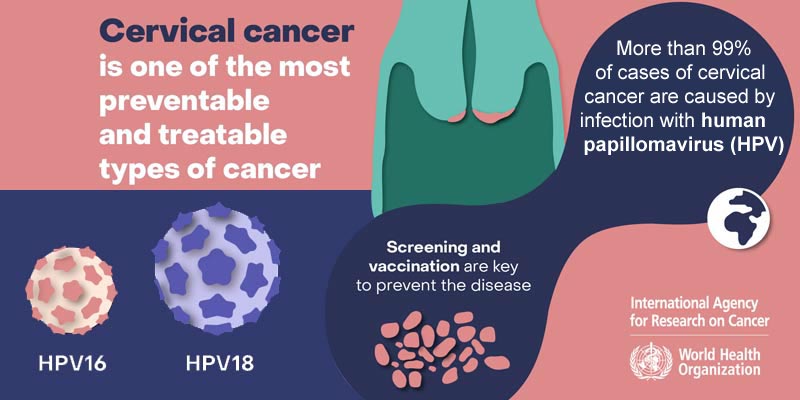
• Almost all cervical cancer cases are linked to infection with high-risk human papillomaviruses (HPV).
• HPV is a common sexually transmitted infection.
• It is estimated that HPV types 16 and 18 (HPV-16 and HPV-18) together contribute to approximately 70 per cent of all invasive cervical cancer cases worldwide.
• Although most infections with HPV resolve spontaneously and cause no symptoms, persistent infection can cause cervical cancer in women.
• Cervical cancer is the most common type of cancer caused by HPV.
• Effective primary (HPV vaccination) and secondary prevention approaches (screening for, and treating precancerous lesions) will prevent most cervical cancer cases.
• When diagnosed, cervical cancer is one of the most successfully treatable forms of cancer, as long as it is detected early and managed effectively.
• With a comprehensive approach to prevent, screen and treat, cervical cancer can be eliminated as a public health problem.
• In May 2018, the WHO Director-General announced a global call for action to eliminate cervical cancer, underscoring renewed political will to make elimination a reality and calling for all stakeholders to unite behind this common goal.
• In August 2020 the World Health Assembly adopted the Global Strategy for cervical cancer elimination.
Cervical cancer cases in India
• Cervical cancer ranks as the second most prevalent cancer in India.
• It accounts for nearly one-fourth of the world’s cervical cancer deaths despite being largely preventable.
• Current estimates indicate that every year approximately 1.25 lakh women are diagnosed with cervical cancer, and over 75,000 die from the disease in India.
• The most promising intervention for preventing cervical cancer is vaccination against human papillomavirus (HPV).
• Presenting the Interim Budget for 2024-2025, Union Finance Minister Nirmala Sitharaman said the government will encourage vaccination against cervical cancer for girls in the 9-14 age group.
• Public health is a state subject under the State List of the Seventh Schedule to the Constitution.
• In December 2022, the Centre urged all states and Union Territories to create awareness on prevention of cervical cancer and the importance of HPV vaccine among girl students across the country.
(The author is a trainer for Civil Services aspirants.)