
- World
- Dec 30
Khaleda Zia, Bangladesh’s first female PM, dies at 80
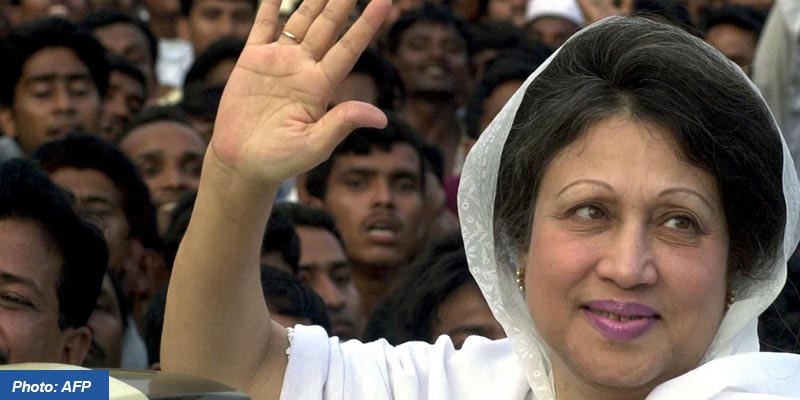
• Bangladesh’s first woman Prime Minister Khaleda Zia passed away on December 30. She was 80.
• She played a major role in restoring democracy after a period of tumultuous military rule and dominated the country’s politics for decades.
• Zia was a three-time Prime Minister and held the position of chairperson of Bangladesh Nationalist Party (BNP).
A political journey spanning over four decades
• Zia was born on August 15, 1946, to Taiyaba and Iskandar Majumdar in Dinajpur district in undivided India.
• Her father migrated from Jalpaiguri, where the family ran a tea business, to what was East Pakistan after the partition.
• In 1960, she married Army Captain Ziaur Rahman.
• Military strongman turned politician Ziaur Rahman grabbed power as a military chief in 1977 and a year later formed the Bangladesh Nationalist Party.
• He was credited with opening democracy in the country, but he was killed in a 1981 military coup.
• Zia was largely unfamiliar with the political world until she was seemingly dragged into it following the assassination of her husband.
• She was enrolled as a primary member on January 3, 1982.
• By March 1983, she became the party’s vice president, and in May 1984, BNP’s chairperson — a position she held until her death.
• After the 1982 military coup by the then Army chief Gen HM Ershad, Zia initiated a movement for restoring democracy.
• After the fall of the Ershad regime in December 1990, a caretaker government headed by Chief Justice Shahabuddin Ahmed conducted the elections in February 1991.
• BNP emerged as the party with the majority to the surprise of many who believed the Awami League would win the polls.
• The new parliament amended the constitution, switching to a parliamentary system from a presidential form of government, and Zia became the first woman Prime Minister in Bangladesh and second in the Muslim world after Pakistan's Benazir Bhutto.
• BNP was re-elected to power in 1996, but the government lasted only 12 days as the Awami League staged vigorous street campaigns.
• Zia’s government quit after introducing the caretaker government system.
• Though BNP lost the fresh election in June 1996, the party won 116 seats, becoming the largest opposition in the country's history.
• In 1999, Zia formed a four-party coalition and launched agitations protesting the then-ruling Awami League government. She was re-elected in 2001.
• In 2006, she stepped down from office, passing power to a caretaker administration.
• In September 2007, she was arrested on what her party claimed were “baseless charges of corruption”.
• On February 8, 2018, she was sentenced to five years in jail in the Zia Orphanage Trust case and later received a seven-year sentence in the Zia Charitable Trust case.
• In 2024, a day after Hasina was ousted from power, Zia was granted a presidential pardon and released.
• Zia visited India twice as the Prime Minister in 1992 and 2006 and once as the opposition leader in 2012 at the invitation of the Indian government.
• Her demise came just days after her elder son and party’s acting chairman, Tarique Rahman, returned to Bangladesh from London on December 25, ending his 17-year self-exile.