
- World
- Jan 03
5 new non-permanent members take their seats in UNSC
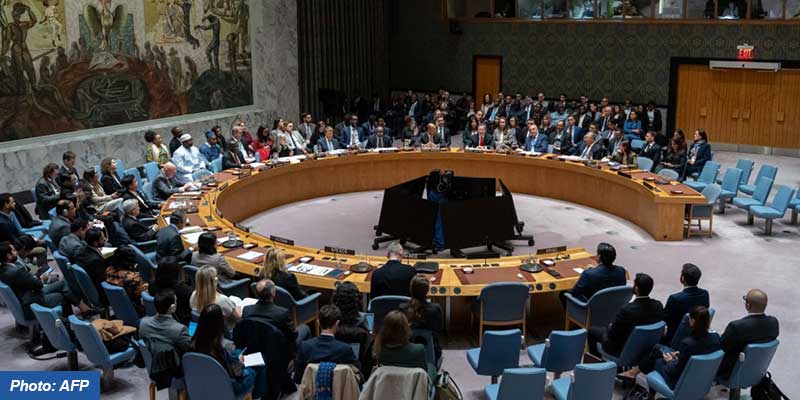
• Five elected members of the UN Security Council officially began their two-year terms on January 2, with five others leaving the world’s premier body for peace and security.
• The new non-permanent members are Bahrain, Colombia, the Democratic Republic of the Congo, Latvia and Liberia.
• They replaced Algeria, Guyana, South Korea, Sierra Leone and Slovenia terms ended on December 31, 2025.
• The new members will join existing non-permanent members Denmark, Greece, Pakistan, Panama and Somalia, who will serve through the end of 2026.
• The Security Council is composed of 15 countries, five of which — China, France, Russia, the United Kingdom and the United States — are permanent members.
• Each month, one Council member serves as President, a role that rotates in English alphabetical order among the 15 members. For January, it is Somalia.
• After a turbulent 2025 that saw escalating warfare and shrinking resources, 2026 will test whether members can help build momentum and open space for decisive action, in a body increasingly shaped by entrenched positions.
• The new members take their seats amid growing geopolitical divisions, with deep disagreements over conflicts such as Ukraine and the Middle East increasingly limiting unified action.
UN Security Council
• The United Nations Charter established six main organs of the United Nations, including the Security Council. It gives primary responsibility for maintaining international peace and security to the Security Council.
• All members of the United Nations agree to accept and carry out the decisions of the Security Council. While other organs of the United Nations make recommendations to Member States, only the Security Council has the power to make decisions that Member States are then obligated to implement under the Charter.
• The Security Council held its first session on January 17, 1946 at Church House, Westminster, London. Since its first meeting, the Security Council has taken permanent residence at the United Nations Headquarters in New York City.
• A representative of each of its members must be present at all times at UN Headquarters so that the Security Council can meet at any time as the need arises.
• The Security Council takes the lead in determining the existence of a threat to the peace or act of aggression.
• It calls upon the parties to a dispute to settle it by peaceful means and recommends methods of adjustment or terms of settlement.
• In some cases, the Security Council can resort to imposing sanctions or even authorise the use of force to maintain or restore international peace and security.
• The Security Council has a presidency, which rotates, and changes, every month.
• The Council is composed of 15 members.
• Five permanent members are: China, France, Russian Federation, the United Kingdom, and the United States.
• Ten non-permanent members are elected for two-year terms by the General Assembly.
The 10 non-permanent seats are distributed on a regional basis as follows:
i) Five for African and Asian States.
ii) One for Eastern European States.
iii) Two for the Latin American and Caribbean States.
iv) Two for Western European and other States.
• Every year, the General Assembly elects five non-permanent members for a two-year term.
• Voting is conducted by secret ballot and candidates must receive a two-thirds majority, or 128 votes, even if they run uncontested.
The right to veto
• The creators of the United Nations Charter conceived that five countries — China, France, the USSR (which was succeeded in 1990 by the Russian Federation), the United Kingdom and the United States — because of their key roles in the establishment of the United Nations, would continue to play important roles in the maintenance of international peace and security.
• They were granted the special status of Permanent Member States at the Security Council, along with a special voting power known as the “right to veto”.
• It was agreed by the drafters that if any one of the five permanent members cast a negative vote in the 15-member Security Council, the resolution or decision would not be approved.
• All five permanent members have exercised the right of veto at one time or another.
• If a permanent member does not fully agree with a proposed resolution but does not wish to cast a veto, it may choose to abstain, thus allowing the resolution to be adopted if it obtains the required number of nine favourable votes.
• In the years following the end of the Cold War, vetoes were rare, often numbering one or two per year, and sometimes none at all.
• Since the mid-2010s, hands have been raised inside the chamber more often: seven times in 2023 and eight in 2024.
• Diplomats often point to this trend as evidence of widening geopolitical rifts, which have made consensus harder to achieve and limited the Council’s ability to respond decisively.