
- World
- Jan 13
ICJ begins hearings on Rohingya genocide case against Myanmar
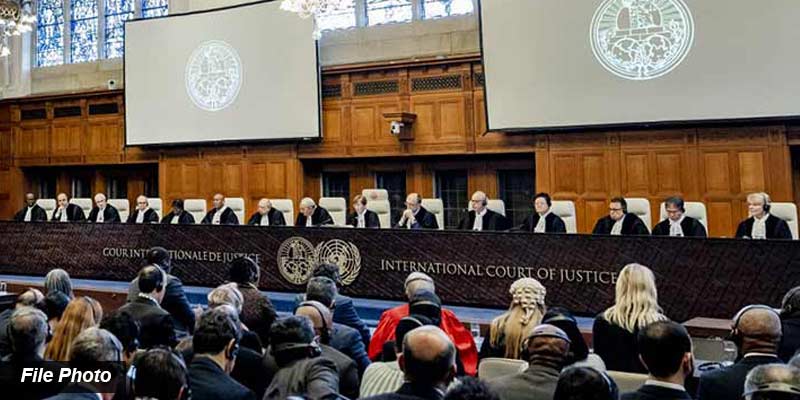
• Public hearings opened at the International Court of Justice (ICJ) on January 12 in a landmark case brought by the Gambia against Myanmar, alleging violations of the Genocide Convention over the military’s treatment of the Rohingya minority.
• The proceedings, held at the Peace Palace in The Hague, mark the start of the merits phase in the case, after years of preliminary legal arguments.
• Over the next three weeks, ICJ judges will hear oral arguments from both sides, examine witnesses and experts, and consider whether Myanmar breached its obligations under the Convention on the Prevention and Punishment of the Crime of Genocide, to which the country is a party.
What is the case about?
• Gambia filed its application in November 2019, accusing Myanmar of breaching the Genocide Convention through acts allegedly committed during so-called “clearance operations” carried out by the Myanmar military, or Tatmadaw.
• Those operations escalated sharply in 2017, prompting more than 700,000 Rohingya to flee to neighbouring Bangladesh amid widespread killings, sexual violence, village burnings and other abuses.
• A UN Human Rights Council-mandated fact-finding mission said in 2018 that it had reasonable grounds to conclude that serious crimes under international law, including genocide, crimes against humanity and war crimes, had been committed.
• Nearly one million Rohingya remain living as refugees in camps in Bangladesh, while countless others are displaced or trapped inside Myanmar in dire conditions.
• In January 2020, the Court unanimously ordered provisional measures, directing Myanmar to take all steps within its power to prevent genocidal acts against the Rohingya, preserve evidence, and report regularly to the Court on its compliance.
• The military coup in February 2021 overthrew the civilian government and plunged Myanmar into renewed nationwide conflict.
• Myanmar challenged the Court’s jurisdiction, but in July 2022 the judges ruled that they were competent to hear the case.
• Eleven States also made written submissions in support of Gambia’s interpretation of the Genocide Convention.
• The court’s final judgment, which could take months or longer after the hearings conclude, will be legally binding.
The International Court of Justice
• The International Court of Justice (ICJ) is the principal judicial organ of the United Nations.
• It is informally known as the “World Court”.
• It was established by the United Nations Charter in June 1945.
• The first members of the ICJ were elected on February 6, 1946, at the first session of the UN General Assembly. The Court held its inaugural sitting at the iconic Peace Palace in The Hague, on April 18, 1946.
• The Court is composed of 15 judges elected for a nine-year term by the General Assembly and the Security Council of the United Nations.
• The seat of the Court is at the Peace Palace in The Hague (Netherlands).
• Of the six principal organs of the United Nations, it is the only one not located in New York, USA.
The Court has a twofold role:
1) To settle, in accordance with international law, through judgments which have binding force and are without appeal for the parties concerned, legal disputes submitted to it by States.
2) To give advisory opinions on legal questions referred to it by duly authorised United Nations organs and agencies of the system.
• The jurisdiction of the Court comprises all cases which the parties refer to it and all matters specially provided for in the Charter of the United Nations or in treaties and conventions in force.
• The Court can only hear a dispute when requested to do so by one or more States. It cannot deal with a dispute on its own initiative. Neither is it permitted, under its Statute, to investigate and rule on acts of sovereign States as it chooses.
• States which are not members of the United Nations may become parties to the Statute of the Court on conditions to be determined in each case by the General Assembly upon the recommendation of the Security Council.
Composition of the Court
• The ICJ comprises 15 judges, who are each elected to a nine-year term of office and may be re-elected.
• In order to ensure a measure of continuity in the composition of the Court, one-third of the membership is renewed every three years.
• Judges must be elected from among persons of high moral character, who possess the qualifications required in their respective countries for appointment to the highest judicial offices, or are jurisconsults of recognised competence in international law.
• The Court may not include more than one national of the same State. Moreover, the Court as a whole must represent the main forms of civilisation and the principal legal systems of the world.
• Once elected, a member of the Court is a delegate neither of the government of his own country nor of that of any other State.
• Unlike most other organs of international organisations, the Court is not composed of representatives of governments. Members of the Court are independent judges whose first task, before taking up their duties, is to make a solemn declaration in open court that they will exercise their powers impartially and conscientiously.
• Members of the Court are elected by the General Assembly and by the Security Council through parallel procedures.
• Both organs vote at the same time but independently of one another.
• This system is intended to ensure, as far as possible, that the vote in one organ does not influence the vote in the other.
• In order to be elected, a candidate must obtain an absolute majority of votes both in the General Assembly and in the Security Council.
• Currently, 97 votes out of 193 constitute an absolute majority in the General Assembly.
• In the Security Council, where no right of veto applies for the purpose of the election and no distinction is made between the votes of the permanent and non-permanent members of the Council, eight votes out of 15 constitute an absolute majority.
How is ICJ different from ICC?
• The International Criminal Court (ICC) is an independent judicial body with jurisdiction over persons charged with genocide, crimes against humanity and war crimes.
• The ICC is not part of the UN.
• Situated in The Hague, Netherlands, the ICC is governed by the Rome Statute adopted by the UN in 1998. It entered into force in 2002 upon ratification by 60 States.
• The ICC is established to investigate, prosecute and try individuals accused of committing the most serious crimes of concern to the international community.
• International Court of Justice (ICJ) is the principal judicial organ of the United Nations for the settlement of disputes between States.
• The ICJ has no jurisdiction to try individuals accused of war crimes or crimes against humanity.
Additional Read:
What is the Genocide Convention?
The Convention on the Prevention and Punishment of the Crime of Genocide (Genocide Convention) is an instrument of international law that codified for the first time the crime of genocide. Its adoption marked a crucial step towards the development of international human rights and international criminal law as we know it today.