
- World
- Jan 22
World’s oldest cave art discovered in Indonesia
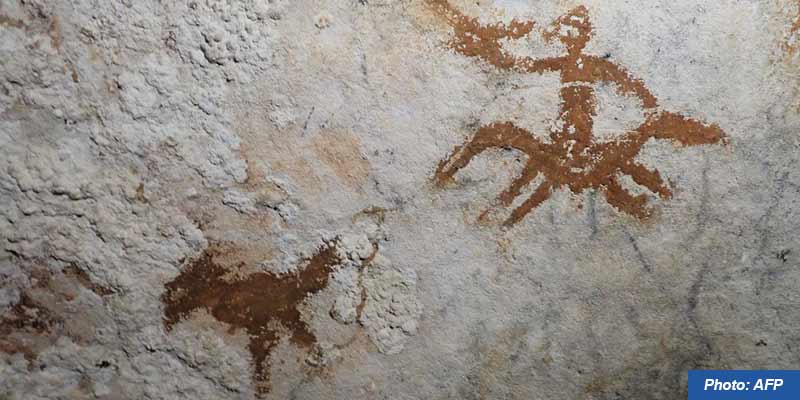
• Archaeologists discovered a hand stencil on the wall of a cave in Indonesia as the oldest known rock art in the world.
• An international team, co-led by Griffith University researchers, Indonesia’s national research and innovation agency (BRIN) and Southern Cross University, discovered and dated cave paintings made on the island of Sulawesi at least 67,800 years ago.
• Preserved in limestone caves in southeastern Sulawesi on the satellite island of Muna, a fragmentary hand stencil was found surrounded by painted art of a much more recent origin.
• The team applied advanced uranium-series dating techniques, analysing microscopic mineral deposits that formed both on top of and, in some cases, beneath the paintings from Liang Metanduno, providing a time period during which the art was made.
• The hand stencil was dated to a minimum of 67,800 years ago, making it the oldest reliably dated cave art yet discovered.
• It is said to be older than a cave painting depicting three human-like figures interacting with a pig dated to at least 51,200 years ago at the Leang Karampuang site in southwestern Sulawesi.
• It also is older than rock art in the form of a hand stencil at Maltravieso in Spain that dates to around 64,000 years ago and has been attributed to Neanderthals.
• The new finding also revealed the Muna cave was used for making art over an exceptionally long period, with paintings produced repeatedly for at least 35,000 years, continuing until about 20,000 years ago.